If you have yet to read Sara VanDerWerf's post about her 5 X 5 game go here and read it now. It sounds awesome, doesn't it? I didn't read it until I was already on break, but I look forward to playing it with my students at some point down the road.
At a very early hour this morning, I thought that this game could be modified to help students practice working with logarithms. Instead of having the numbers 1-10 in their grid, they could have logs. They would still place numbers of equal value next to each other, but some would look like log28, others like log327 and others like 3. They would also still need to find the sum of squares that match. I would have them write the sum of each set of matching expressions as a single logarithm so that they would need to use their log rules.
Clearly, I need to actually work through this, but I wanted to get it down before I forgot. I think you could also do this with trig expressions (sin π/6, cos 5π/3, etc.), but have thought that through even less than the log idea.
If you have feedback, please let me know. Ideas to build on or telling me why this is a bad idea are both welcome :)
Today is our last day before the break. This generally means treats, music and movies throughout the school, with very little, if any, work being done. However, 11 of my students opted to rewrite the skills portion of the quadratics test from Monday. I didn't even have 11 students show up to my grade 12 class first period! Their dedication to learning and improving is remarkable. I feel very privileged to be their teacher.
Happy holidays to all!
Day 68
Yesterday was day 2 of the test. I don't really want to talk about it...
Day 69
We changed gears completely today and looked at the equation of a circle. This is one of those weird topics in our curriculum that doesn't really fit in. I do it as an application of the distance formula, but we only look at circles centered at the origin so I don't even get to make connections to the transformations we have done. Well, it's not part of the curriculum, but I usually have them explore circles that are not centered at the origin.
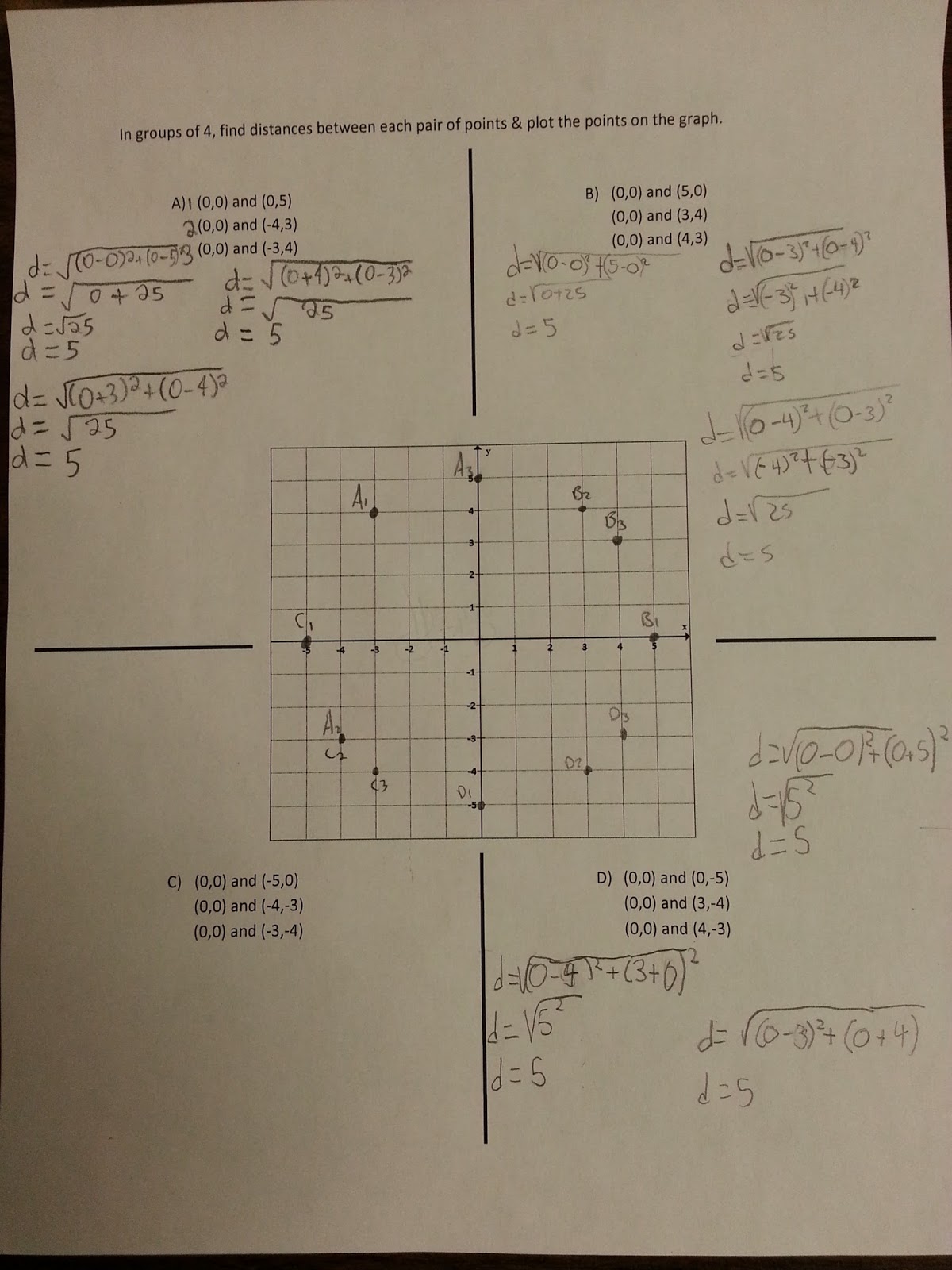
I started off with a little group activity. They had to plot 12 points and calculate the distance between each point and the origin. This is what it looked like:
They easily saw the pattern (all the answers were 5!) and that the points formed a circle. So then I asked them to define a circle. Here is what they said:
Pretty good, right? We went on to develop the equation of a circle.
Then they filled in a big table giving them different information (equation, radius, intercepts, graph).
Next, we looked at this question:
We hopped onto Desmos to see what this looked like. They could easily see if a point was inside, outside or on the circle, so they talked in their groups about how we could figure this out without the picture.
In our discussions, we talked more about radius that radius squared, so that is how we looked at the example that follows.
And then class ended early so students could go clean up their lockers. They were not sad about not getting homework.
Today, students had the opportunity to work on review questions (quadratics) and ask for help. I returned yesterday's test and went over the questions where they had to solve a quadratic. We also spent a little bit of time talking about how to determine the number of real roots of a quadratic. I like having a day in between test days as it gives students a chance to refocus and ask questions about skills which with they are struggling.
Completely off topic, if you haven't checked out Desmos' latest activity, Marbleslides, go do that now! Here is the link to the quadratic one.
Not much to report today. Test day is always a combination of feelings. Satisfaction that some students have really understood the material, combined with sadness that some really have not. I have to push down that voice that wants to say "But we did this!" as the evidence clearly shows that some just didn't get it. More work tomorrow to prepare for part II of the test on Wednesday.
I collected some great quadratic summaries today and asked four students if I could scan their work and post it on Edmodo. I like students to be able to see each other's work.
They spent the period working on review questions. The cycle 3 test will be over two days. The first day will cover mixture-type linear system questions, shortest distance between a point and a line and some of the skills of quadratics (factoring, completing the square...). The second day will be all about quadratics where they have to choose the right tool to answer the question and interpret answers as necessary.
What's left in the course? Sine and cosine law, comparing y = 2^x and y = x^2 and equations of circles centered at the origin. I think we will look at y = 2^x (and negative exponents) next Thursday and do Penny Circle on Friday and save the rest for January.
We started today with a couple of leftover examples from yesterday.
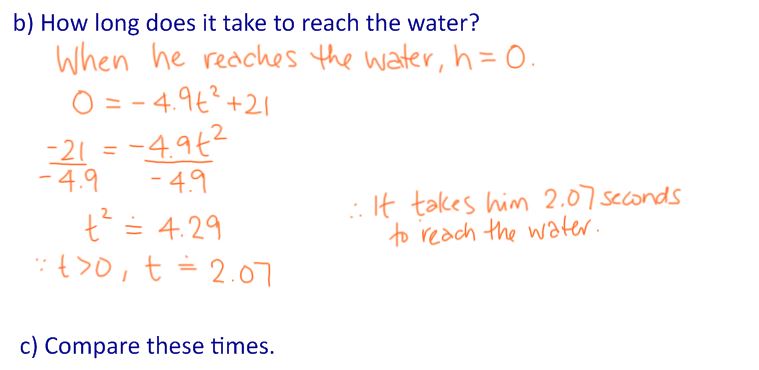
We talked about the fact that the second answer is not double the first as the diver is speeding up.
They had done problems similar to the next one for homework, but I wanted to make sure that they were all solid on how to approach this type of question.
Then we moved on to making frames, inspired by (stolen from) Fawn Nguyen. Here is her post about it.
Each pair got one picture (I use black & white pictures as they look better photocopied) and four frames (on thicker paper) to work with as I told them their first attempt would likely be unsuccessful, but that they should learn from it.
Eventually they wanted help. They didn't quite beg for it but they did ask for the math that would help them. That was good. I gave them this and let them have a little more time to work it out.
Then we went over the solution together.
Here is one group's finished product!
After that they worked on one more problem.
Time was tight so we looked at the solution in a Desmos kind of way. I explained how to set up the equation - that the variable was the number of decreases in price. They usually find these questions tough.
And their homework for today:
I left it very open-ended as I want them to make something that is meaningful for them.