The plan for today was to get through exponent laws. Tomorrow will likely be a snow day so I wanted them to have the tools to be able to practice working with exponents and order of operations. We had not worked through the examples planned for yesterday so I photocopied the questions and let them work through them in their table groups instead of a warm up.
Lots of misconceptions arose and their understanding of both exponents and the order of operations seems to be improving. I decided on the weekend that order of operations is really the crucial foundation they need to build on. If that is not solid, the rest will fall apart.
Next, they worked on this question in groups:
The conversations were really interesting to listen to. Many groups took our calculators only to find that they weren't helpful as the question asked the expression to be simplified, not evaluated. I'm not sure how much this shows, but this is our consolidation.
I am being very intentional about saying "simplifies to 1" and not "cancels".
We broke things up a little to state each exponent law individually.
We had a little time left to try putting it all together before summarizing.
Though it seemed a bit rushed to me, we focused on understanding, not memorizing rules. Hopefully the practice they will get over the next couple of snowy days will serve them well.
We started today's class by finishing the examples from Friday.
Then I had them do today's warm up in random groups on the white boards.
I asked them to sit down when they finished, but they wouldn't! They were busy comparing answers and trying to figure out who was right and fixing mistakes and it was fantastic! They did eventually all sit down and we talked about the order of operations.
Then we returned to the warm up which they each completed individually before we took it up together. Some were feeling much more confident this time around.
In light of the 40 cm of snow heading our way Tuesday night into Wednesday, I skipped today's visual pattern :(
Instead, we launched into exponents. I try to emphasize that an exponent affects only what is immediately in front of it and try to help them make sense of negative numbers raised to an exponent.
Somewhere along the way I returned their quizzed to be corrected tonight. Their quizzes were actually quite encouraging.
After handing back feedback forms, I asked students to take out, but not hand in their homework (they normally hand it in at the beginning of each class, I check it somewhere along the way and return it before the end of class). I asked whether they knew that the answers were in the back of the book and this was news to many! So together we found the answers and I had them check their answers and place a check mark or x next to each question using a different coloured pen. Then they handed it in to me. This simplifies my job as it became very clear whether they struggled with any of the questions. Sometimes we forget the soft skills so I am trying to be deliberate in imparting them to my students.
Instead of a warm up today, I gave a quiz on integers. I realized last night (it was our school's open house so I was here until 8 pm) that I have no firm evidence that my students are understanding the material we have looked at thus far. I made sure to explain to them that they shouldn't be stressed about it, that it would help me know if we need to spend more time on integers or if we are ready to move on.
After the quiz we carried on where we left off yesterday - like terms.
The next question sounds like a Marian Small question so I will give her credit. My students did well with answering it, but we had to work hard to explain what everyone's answers would have in common.
Then we practiced combining like terms and dealing with the many misconceptions that came up along the way.
I loved the multiple ways of writing the solution to this next example.
We skipped today's visual pattern, in part because the teacher next door had borrowed my cards, and in part because I wanted to get everyone feeling a little more comfortable with the distributive property before the weekend. We worked through area models with numbers then added a variable. A big thank you to Sheri Walker for sharing this handout with me. Students who were unsure were encouraged to count the number of x tiles to get the area and then try to make sense of that answer in terms of length and width.
We continued to build up our area models and were careful about including brackets when writing out the length x width expressions.
A little summary and some more examples (I know this is not very exciting - I would change this to become work on whiteboards next time. Actually I can do some of that next class.)
We had a few more to do, but it was the end of the period so that's the end of the first week.
Today started with a warm up and the small whiteboards.
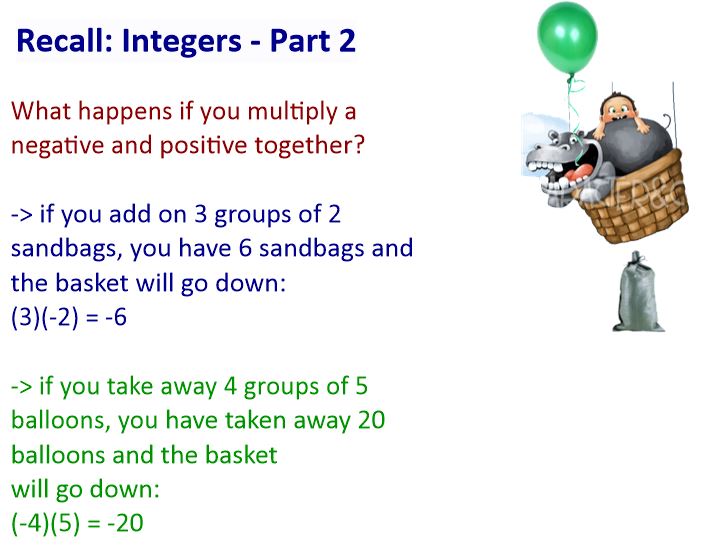
Again, there were many different answers so we went over a few things. We talked about what the dot means and why it is used and a little about order of operations - that multiplication happens before addition or subtraction. Then we did a little recall on multiplying with integers.
We went back to the warm up and I gave them a minute or two to check their work before we took it up.
I took out my playing cards and they created groups for today's visual pattern. They worked on the whiteboards and are slowly getting better at showing the link between the pattern and the algebraic expression. Here is one sample and the sample solution I showed them.
Next we moved on to the activity that we didn't have time for yesterday. I had prepared a brown paper bag with algebra tiles for each pair of students.
We went over what each tile represented before they tried this out. It seemed to solidify the concept of zero pairs pretty well.
Next we did a more formal lesson on like terms. Well, we started. We didn't get through everything and I have to remember that rushing through material serves no one. If I try to think positively, I have part of my lesson for tomorrow ready to go!
We did example 1 as a class - it was a good consolidation of the activity they had just done.
We defined like terms and started on the next example which produced some really good discussion.
And that's all for today. I know we are doing a lot each day so I need to consider whether I need to make some adjustments to my plan to provide a little more breathing room.
We didn't have class yesterday as the school buses were cancelled, so I'm considering today as day 2.
Before class I handed out small whiteboards and markers and organized bags of algebra tiles (which I won't get to until tomorrow as it turns out).
We started with this warm up which students did on their small whiteboard:
I circulated and then wrote - 10, -5, -2, -6, -4, -7, IDK on the board. Those were some of the answers I had seen. Clearly we had work to do. The reason I wrote all of those answers was for them to see that many students didn't know how to do this correctly - that if they didn't get it right, it was okay. We would work on it together. We then talked about adding and subtracting integers (I have an old blog post about this here).
Then I let them try the warm up question again with much better results.
Next up, today's visual pattern (#129 but I removed the colour as I found it too leading). We used cards to create random groups of three and their task was to figure out the rule for the pattern in as many ways as possible.
I confess that I didn't circulate, listen and engage with my students enough while they were doing this as I was also handing out textbooks. However, I was really pleased with the work they did, the fact that no one went to a table and that they are starting to be able to show their thinking. Here are some samples (some got a little help connecting the representations from me):
I had two possible ways of seeing this pattern ready to go, but added a third to capture some of their thinking - many groups made a constant in the middle of the vertical part. Here are those:
I love that there are so many different ways of seeing these patterns and am always impressed when my students show me a new way of seeing it.
Next, we talked about algebraic models: using algebra tiles to represent expressions.
We had just enough time for them to try a couple of examples. Honestly, I was too rushed doing this and should really have let touch the actual tiles to truly understand. I will fix that tomorrow.
We wrapped up by returning feedback forms (not sure I talked about those - read about them here).
I'm dusting off the old blog to help me reflect on my first unit of grade 9 academic math. I last taught this course in 2013 and was not happy with how the first unit went so I am making some changes this time around. My plan is to blog daily so that I have a record of what I did, how things went, and what I would do differently next time.
Unit 1 is all about polynomials. Like terms, distributive property, exponent rules. All mixed in with integers and fractions, which are pretty shaky concepts for many of our students. My plan is to work on integers and fractions as daily warm-ups and through the lessons to slowly bring everyone up to the level they need to be in order to be successful. But I'm getting ahead of myself.
Today we started with a puzzle that I found in our textbook (McGraw-Hill Ryerson). I had students pick cards to form random groups of 3 and they worked at the whiteboards around the room.
I included a hidden extra clue but none of the groups needed it (yay!). They did really well, in terms of the mathematics but also working in teams. I had an extension ready to go for the groups that finished quickly - I asked them to work on creating their own magic square (still 4 x 4) but using some negative numbers. That was very challenging, so I think I might ask them to create a 3 x 3 one next time around.
With about 20 minutes remaining (our classes are 75 minutes long), we started our first visual pattern together. If you are not familiar with visual patterns you should head over to Fawn Nguyen's site by clicking here.
We came up with three different ways of seeing the pattern growing. For each one we came up with the rule based on the step number.
i was pleased with their willingness to work with the pattern and not jump to a table. We will do more tomorrow.
I also asked them to create DeltaMath.com accounts. They will be able to get extra practice there.