Day 67
Day 2 of cycle 3 test was as expected. A lot of "I quit", following by me saying "No" and asking a few questions to get them going again. Most finished, or did all that they could, and a few will continue on Monday.
I have been thinking about the tree activity since meeting up with Alex & Sheri on Wednesday. One of the things we discussed was that we wanted more activities that covered multiple curriculum expectations. This activity has a definite focus on the measurement expectation, but I think we can tie a lot more to it:
* Growth of the tree over time = linear relationship
* Growth of different species of trees, one starting out taller than the other = system of equations
* Area of root bed (diameter is approximately equal to the height) vs. height? = quadratic relationship
* Finding height of the tree = similar triangles / trigonometry
* Number of board-feet of lumber vs. diameter = quadratic relationship
I plan on doing this activity earlier in the semester next time around, with all these added parts. Comments and suggestions welcome!
Friday, 23 May 2014

Thursday, 22 May 2014
Day 66
Day 66
Today was test day. The fact that the building was shaking during much of the period due to paving going on behind the school, did not help students focus well. However, we got through day 1. No one finished the test today, but they have tomorrow to work on it too. I hope some will spend some time tonight reviewing concepts with which they struggled. I will continue in my role of cheerleader - encouraging them, prompting as necessary and generally keeping them moving forward.
Today was test day. The fact that the building was shaking during much of the period due to paving going on behind the school, did not help students focus well. However, we got through day 1. No one finished the test today, but they have tomorrow to work on it too. I hope some will spend some time tonight reviewing concepts with which they struggled. I will continue in my role of cheerleader - encouraging them, prompting as necessary and generally keeping them moving forward.
Wednesday, 21 May 2014
Collaboration
I had the good fortune of spending today working with Alex Overwijk and Sheri Walker. We are all teaching grade 10 applied math this semester and have been spiraling through the curriculum doing activities most days. Saying that this has been a great experience is an understatement. I have no doubt that my students have benefited from learning this way (even if they may not always realize it). I would not teach this course ever again in any kind of "traditional" way.
Today we spent time going over the summative prep activity, which Alex did last semester and blogged about here. We talked about how to make it work, fixed up some of the pictures and created a 6th theme. We also spent time looking at Graphing Stories, Daily Desmos, Mathalicious and other cool sites before working on a new activity together. We came upon this activity by the awesome Robert Kaplinsky (@RobertKaplinsky). Hot dogs + linear + quadratic = cool! We liberally stole the idea and adapted to mini-marshmallows so that our students can actually collect the data themselves, without getting sick (hopefully). Together we came up with some good questions to follow up the data collection/graphing/finding equations part of the activity. I really love the way we bounced ideas off each other and thought about the activity in different ways. And I think what we ended up with will be good
Throughout the day we had conversations about what we are looking for in activities, what makes them "good". We talked about the effect teaching this way may have on our students - about how they will retain more of what they learn and that they will hopefully have a more positive attitude toward math. And we all know that this is a journey where the finish line is always moving so we will never be "done". I'm just really fortunate to be making the journey in such good company.
Today we spent time going over the summative prep activity, which Alex did last semester and blogged about here. We talked about how to make it work, fixed up some of the pictures and created a 6th theme. We also spent time looking at Graphing Stories, Daily Desmos, Mathalicious and other cool sites before working on a new activity together. We came upon this activity by the awesome Robert Kaplinsky (@RobertKaplinsky). Hot dogs + linear + quadratic = cool! We liberally stole the idea and adapted to mini-marshmallows so that our students can actually collect the data themselves, without getting sick (hopefully). Together we came up with some good questions to follow up the data collection/graphing/finding equations part of the activity. I really love the way we bounced ideas off each other and thought about the activity in different ways. And I think what we ended up with will be good
Throughout the day we had conversations about what we are looking for in activities, what makes them "good". We talked about the effect teaching this way may have on our students - about how they will retain more of what they learn and that they will hopefully have a more positive attitude toward math. And we all know that this is a journey where the finish line is always moving so we will never be "done". I'm just really fortunate to be making the journey in such good company.
Tuesday, 20 May 2014
Days 64 & 65
Day 64
The first day back from a long weekend can be a struggle and it certainly was this morning. To be clear, I mean for my students, not for me. Although I was uptight too, as I felt the pressure of getting through today's work as the cycle 3 test is on Thursday. I normally take the time I need to work through concepts, but today, we had to get factoring monic trinomials done. It's amazing how putting pressure on myself affects how I teach - I had to force myself to stop worrying and just work with what they were giving me.
I started the class with multiplying two binomials again. I think they can do this in their sleep now. Then we talked about what information we can get from each form of the equation. We can read off the zeros if the equation is in factored form and can read off the y-intercept if the equation is in standard form. Then I asked where the vertex would be. We sketched what we knew and then they were stuck.

Desmos to the rescue! Here is the graph, conveniently not showing the vertex. They seemed to have no idea where the vertex might be. (You know, in between the talking and texting and generally not paying attention to what we were working on.)

I asked them if the vertex would be the to right of both zeros, to the left of both zeros, or between them. We agreed it had to be between them, so I asked where. They started throwing out random numbers so I added a potential line of symmetry to my graph. Is the vertex at x = -5? No. So, where is it?

We tried x = - 3 and x = -2 and finally someone said x = -2.5. And then we zoomed out and saw all the key points.

I'm pretty sure they understood that if they move in the same number of units from each zero, they will land on the axis of symmetry. Okay, time to move on.
Hopefully they saw the use of factored form as we launched into our second day of factoring using algebra tiles.

They seemed to do a good job of creating a rectangle with the algebra tiles and of stating the "length" and "width".
We used Gizmos to look at quadratics with negative terms. They practiced afterwards and, after some one-on-one or group help, were really grasping when they needed to add zero pairs to be able to factor. We did difference of square questions this way too; I'm hoping that they will notice a pattern next time we take a look at these.
Day 65
We, that's Alex Overwijk (@AlexOverwijk), Sheri Walker (@SheriWalker72) and I, are having our final MFM2P meeting tomorrow, so I will be away from my school. I have made a lovely review package for my crew to work on in preparation for Thursday's test. I would like to publicly say a huge thank you to Alex for sharing his time, activities and experience with us this semester. I may have jumped into the deep end of the pool, but I did so knowing that he was there if I ever needed a rescue. I have loved the collaboration and hope it will continue beyond June.
The first day back from a long weekend can be a struggle and it certainly was this morning. To be clear, I mean for my students, not for me. Although I was uptight too, as I felt the pressure of getting through today's work as the cycle 3 test is on Thursday. I normally take the time I need to work through concepts, but today, we had to get factoring monic trinomials done. It's amazing how putting pressure on myself affects how I teach - I had to force myself to stop worrying and just work with what they were giving me.
I started the class with multiplying two binomials again. I think they can do this in their sleep now. Then we talked about what information we can get from each form of the equation. We can read off the zeros if the equation is in factored form and can read off the y-intercept if the equation is in standard form. Then I asked where the vertex would be. We sketched what we knew and then they were stuck.
Desmos to the rescue! Here is the graph, conveniently not showing the vertex. They seemed to have no idea where the vertex might be. (You know, in between the talking and texting and generally not paying attention to what we were working on.)
I asked them if the vertex would be the to right of both zeros, to the left of both zeros, or between them. We agreed it had to be between them, so I asked where. They started throwing out random numbers so I added a potential line of symmetry to my graph. Is the vertex at x = -5? No. So, where is it?
We tried x = - 3 and x = -2 and finally someone said x = -2.5. And then we zoomed out and saw all the key points.
I'm pretty sure they understood that if they move in the same number of units from each zero, they will land on the axis of symmetry. Okay, time to move on.
Hopefully they saw the use of factored form as we launched into our second day of factoring using algebra tiles.
They seemed to do a good job of creating a rectangle with the algebra tiles and of stating the "length" and "width".
We used Gizmos to look at quadratics with negative terms. They practiced afterwards and, after some one-on-one or group help, were really grasping when they needed to add zero pairs to be able to factor. We did difference of square questions this way too; I'm hoping that they will notice a pattern next time we take a look at these.
Day 65
We, that's Alex Overwijk (@AlexOverwijk), Sheri Walker (@SheriWalker72) and I, are having our final MFM2P meeting tomorrow, so I will be away from my school. I have made a lovely review package for my crew to work on in preparation for Thursday's test. I would like to publicly say a huge thank you to Alex for sharing his time, activities and experience with us this semester. I may have jumped into the deep end of the pool, but I did so knowing that he was there if I ever needed a rescue. I have loved the collaboration and hope it will continue beyond June.
Friday, 16 May 2014
Day 63
Day 63
Today was Tournament of Champions. This means that 20-25% of the school population is doing sports outside all day. And that many of the rest of the school population doesn't show up. I was expecting 12 of my 24 MFM2P students and 5 showed up. Sigh... They tried to convince me that we should watch a movie or something, to no avail. I had plans!
We started with a few Estimation 180 questions. Song length, which they nailed, then a few flight distance questions. And I have to say that I took issue with this:

Ontario is a pretty big place. Over 1 million km^2, in fact. Maybe you could pick a city, like Ottawa : ) (In all seriousness, I love what Andrew Stadel has done with this site and am very thankful for all the time and effort he spent creating this. I'm not actually complaining!)
Then we moved on the main event. I showed them this picture. Act I.


And their job, as a group of 5, was to come up with questions.
They did an amazing job! They were so supportive of each other. I heard things like "That's a good one!" and they built on each other's questions. Here is their list (who says no one writes in cursive anymore!):


I then asked them to choose one question that they would actually answer. They talked about what information I might be able to provide for them and then I showed them this (Act II):

They settled on answering one of the "volume" questions. We talked about what shape the tree was - not quite a cylinder, sort of a cone (I showed them what a frustum is). They decided to find the area using the volume of a cylinder. We discussed which radius measurement they should use and they chose the middle one as it might compensate for the trunk being wider at the bottom and narrower at the top. I would have liked someone to suggest comparing that to the average of the radii at the lower and higher heights, but with a group of 5...
They were great about reminding each other to use consistent units. Here are their calculations:

I wanted them to have some perspective on this answer so I had a student look up the volume of an Olympic size pool, which is 2500 m^3. You could fill almost 3/4 of an Olympic pool with the wood from this one tree!
Then for Act III, we looked at the answer.

(You didn't actually think I would tell you the answer, did you?)
I asked which of the questions they now wanted to answer. They settled on "How much firewood?" as it seemed more manageable than the "How many toothpicks?" question. They estimated the size of the log (they are so confident doing this thanks to Estimation 180), first in feet then decided they needed to work in metres. I brought over a metre stick to help them visualize. Their calculations are above. They struggled making sense of their answer for the volume of 1 log, as it was in m^3. I love that they do think about whether an answer seems reasonable.
(My sequel looked like this... but I went with what they were interested in finding out instead.)

I then asked them each to calculate how many of something they could make from this tree. Here are some of the results:
Number of sheets of paper:

Number of metre sticks:
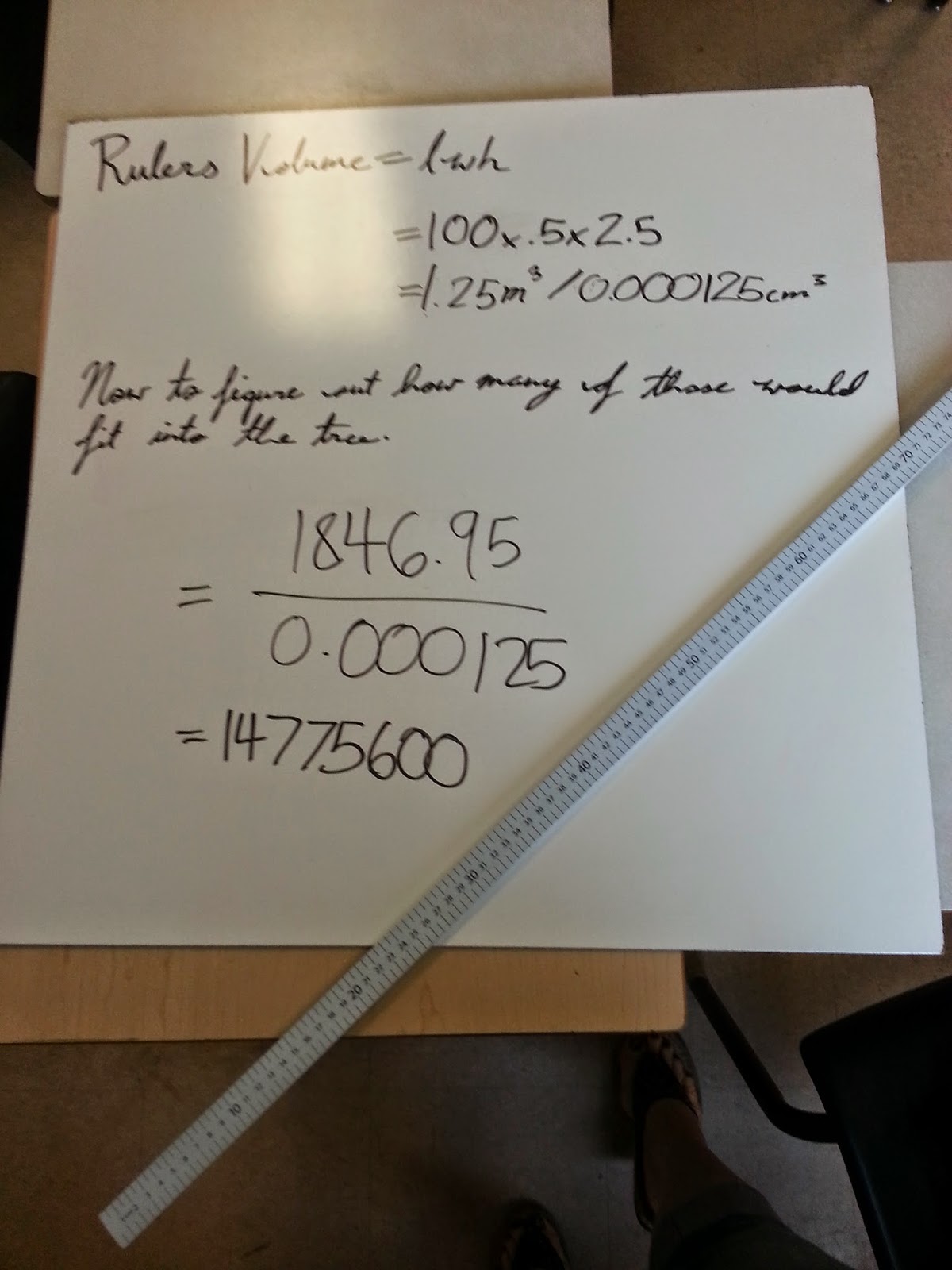
Number of toothpicks:

At this point the school went into "safe school" mode which means that no one is allowed out of class. The Tournament of Champion players were all around the hallways so I ushered a number of them into my classroom. They joined in on the tree questions and added a few to our list:
- How many people would it take to link arms around the tree?
- How many people would it take to touch the top of the tree?
- Using the average height of its surrounding trees, how many trees would it take to reach the top?
-What is the % chance of the tree being the coolest tree fort ever?
I love that the older students who came in to our class joined in and valued what my students were doing. I love that they came up with a lot of the same questions that my gang had come up with, but not all of them. I was really proud of my little class today - they did great work.
Today was Tournament of Champions. This means that 20-25% of the school population is doing sports outside all day. And that many of the rest of the school population doesn't show up. I was expecting 12 of my 24 MFM2P students and 5 showed up. Sigh... They tried to convince me that we should watch a movie or something, to no avail. I had plans!
We started with a few Estimation 180 questions. Song length, which they nailed, then a few flight distance questions. And I have to say that I took issue with this:
Ontario is a pretty big place. Over 1 million km^2, in fact. Maybe you could pick a city, like Ottawa : ) (In all seriousness, I love what Andrew Stadel has done with this site and am very thankful for all the time and effort he spent creating this. I'm not actually complaining!)
Then we moved on the main event. I showed them this picture. Act I.
And their job, as a group of 5, was to come up with questions.
They did an amazing job! They were so supportive of each other. I heard things like "That's a good one!" and they built on each other's questions. Here is their list (who says no one writes in cursive anymore!):
I then asked them to choose one question that they would actually answer. They talked about what information I might be able to provide for them and then I showed them this (Act II):
They settled on answering one of the "volume" questions. We talked about what shape the tree was - not quite a cylinder, sort of a cone (I showed them what a frustum is). They decided to find the area using the volume of a cylinder. We discussed which radius measurement they should use and they chose the middle one as it might compensate for the trunk being wider at the bottom and narrower at the top. I would have liked someone to suggest comparing that to the average of the radii at the lower and higher heights, but with a group of 5...
They were great about reminding each other to use consistent units. Here are their calculations:
I wanted them to have some perspective on this answer so I had a student look up the volume of an Olympic size pool, which is 2500 m^3. You could fill almost 3/4 of an Olympic pool with the wood from this one tree!
(You didn't actually think I would tell you the answer, did you?)
I asked which of the questions they now wanted to answer. They settled on "How much firewood?" as it seemed more manageable than the "How many toothpicks?" question. They estimated the size of the log (they are so confident doing this thanks to Estimation 180), first in feet then decided they needed to work in metres. I brought over a metre stick to help them visualize. Their calculations are above. They struggled making sense of their answer for the volume of 1 log, as it was in m^3. I love that they do think about whether an answer seems reasonable.
(My sequel looked like this... but I went with what they were interested in finding out instead.)
I then asked them each to calculate how many of something they could make from this tree. Here are some of the results:
Number of sheets of paper:
Number of metre sticks:
Number of toothpicks:
At this point the school went into "safe school" mode which means that no one is allowed out of class. The Tournament of Champion players were all around the hallways so I ushered a number of them into my classroom. They joined in on the tree questions and added a few to our list:
- How many people would it take to link arms around the tree?
- How many people would it take to touch the top of the tree?
- Using the average height of its surrounding trees, how many trees would it take to reach the top?
-What is the % chance of the tree being the coolest tree fort ever?
I love that the older students who came in to our class joined in and valued what my students were doing. I love that they came up with a lot of the same questions that my gang had come up with, but not all of them. I was really proud of my little class today - they did great work.
Thursday, 15 May 2014
Day 62
Day 62
We explored quadratic scenarios a little more today. I loved it when one student said "That's it? That's easy.". My students can be very needy, but do great things with a little support and encouragement. We ended this portion by summarizing all 7 scenarios which allowed them to see the similarities and what they need to remember (things like symmetry) along the way.
Next up, factoring! Out came the algebra tiles and my doc cam. We started with common factoring, focusing on the fact that we are taking the area of a rectangle and finding out its length and width. If there is more than one way to make the rectangle, then we want the one closest to a square. Here is my written version of some of the algebra tiles work:

We talked about why a quadratic equation in factored form might be more useful than one in standard form, and went over how to find the zeros again (with a little help from Desmos). We put it all together with this example:
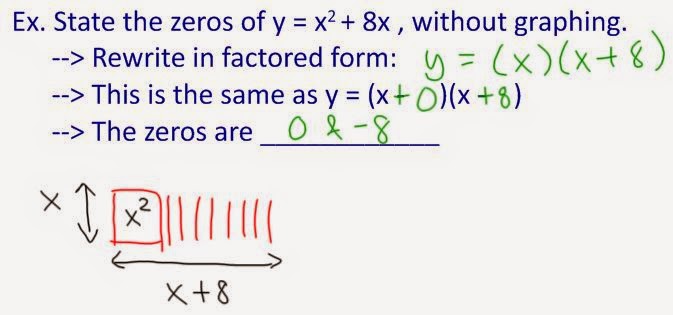
And that was it for today. I think we laid a good foundation for factoring monic trinomials. I'm not sure if I'll do that tomorrow as there are going to be a lot of students away due to Tournament of Champions and I want to make sure they all see how to factor.
As a side note, it was really great to have a student ask if she could explain SOH-CAH-TOA to a student who was away when we did that. The fact that she was able to explain it to her friend well means that she really did understand it. This makes me happy. The fact that she wanted to explain made me happier still.
We explored quadratic scenarios a little more today. I loved it when one student said "That's it? That's easy.". My students can be very needy, but do great things with a little support and encouragement. We ended this portion by summarizing all 7 scenarios which allowed them to see the similarities and what they need to remember (things like symmetry) along the way.
Next up, factoring! Out came the algebra tiles and my doc cam. We started with common factoring, focusing on the fact that we are taking the area of a rectangle and finding out its length and width. If there is more than one way to make the rectangle, then we want the one closest to a square. Here is my written version of some of the algebra tiles work:
We talked about why a quadratic equation in factored form might be more useful than one in standard form, and went over how to find the zeros again (with a little help from Desmos). We put it all together with this example:
And that was it for today. I think we laid a good foundation for factoring monic trinomials. I'm not sure if I'll do that tomorrow as there are going to be a lot of students away due to Tournament of Champions and I want to make sure they all see how to factor.
As a side note, it was really great to have a student ask if she could explain SOH-CAH-TOA to a student who was away when we did that. The fact that she was able to explain it to her friend well means that she really did understand it. This makes me happy. The fact that she wanted to explain made me happier still.
Wednesday, 14 May 2014
Day 61
Day 61
I remembered to start today's class with Act II of Boat on the River. We had come up with the question yesterday - at what angle does the boat need to be to make it under the bridge safely?
So, Act II -what information do we need? It took no time for my students to tell me that we needed the length of the mast and the height of the bridge. This is what they got:

Hmmm, not actual measurements. Can we use these? Someone said yes. I asked why. Then the magical words "scale factor" were said. Such a happy moment! We went over the idea that because we are calculating a ratio in trig, we don't need to find the actual values for the length of the mast and the height of the bridge. They then set about finding the angle in question and did a good job. It is great to see how well they can apply "SOH-CAH-TOA" because they are so solid on the ratios. We then watched Act III of the video and talked about how the owner of this boat save him/herself a lot of time and money by doing a little research and a little trigonometry.
Next, we jumped into quadratics by looking at work did a while back. They found the zeros of four quadratic equations in factored form given the graphs and noticed a relationship.

We will come back to this when we factor quadratics, but the seed has been planted.
We went over the vocabulary quickly (zero, vertex, y-intercept, axis of the curve...) and then they were paired up to do a little activity, inspired by Dan Meyer. Each student got a sheet that looked something like this:

which they folded in half. The goal was for each student to graph their partner's graph by asking only yes/no answer questions or questions that had a coordinate pair as the answer.
Most groups did a really good job. It was cool to hear the math talk going on and how they explained the concepts to each other. My goal was to ensure that they knew the vocabulary of quadratics and I believe that was accomplished. Here is what it looked like:


Next, still in pairs, they were each given one of the following scenarios:

Their job was to sketch the appropriate quadratic (most were height vs. time or height vs. horizontal distance). In order to do that they had to decide what information they needed and come up with a reasonable estimate for each piece of information. All that Estimation 180 is being put to use! Their handouts looked something like this:

I came up with this activity while covering someone else's class first period this morning so this is classic "just in time" work. But I really, really like this activity. My students looked at it and said "I don't know what to do.", but once I asked them a couple of questions they were off and running. They really needed to think about the situation they were working with to come up with a big picture of what was happening, and then think about what they needed to know to produce a good sketch. I think there is a lot of value in continuing this tomorrow.
I remembered to start today's class with Act II of Boat on the River. We had come up with the question yesterday - at what angle does the boat need to be to make it under the bridge safely?
So, Act II -what information do we need? It took no time for my students to tell me that we needed the length of the mast and the height of the bridge. This is what they got:
Hmmm, not actual measurements. Can we use these? Someone said yes. I asked why. Then the magical words "scale factor" were said. Such a happy moment! We went over the idea that because we are calculating a ratio in trig, we don't need to find the actual values for the length of the mast and the height of the bridge. They then set about finding the angle in question and did a good job. It is great to see how well they can apply "SOH-CAH-TOA" because they are so solid on the ratios. We then watched Act III of the video and talked about how the owner of this boat save him/herself a lot of time and money by doing a little research and a little trigonometry.
Next, we jumped into quadratics by looking at work did a while back. They found the zeros of four quadratic equations in factored form given the graphs and noticed a relationship.
We went over the vocabulary quickly (zero, vertex, y-intercept, axis of the curve...) and then they were paired up to do a little activity, inspired by Dan Meyer. Each student got a sheet that looked something like this:
which they folded in half. The goal was for each student to graph their partner's graph by asking only yes/no answer questions or questions that had a coordinate pair as the answer.
Most groups did a really good job. It was cool to hear the math talk going on and how they explained the concepts to each other. My goal was to ensure that they knew the vocabulary of quadratics and I believe that was accomplished. Here is what it looked like:
Next, still in pairs, they were each given one of the following scenarios:
Their job was to sketch the appropriate quadratic (most were height vs. time or height vs. horizontal distance). In order to do that they had to decide what information they needed and come up with a reasonable estimate for each piece of information. All that Estimation 180 is being put to use! Their handouts looked something like this:
I came up with this activity while covering someone else's class first period this morning so this is classic "just in time" work. But I really, really like this activity. My students looked at it and said "I don't know what to do.", but once I asked them a couple of questions they were off and running. They really needed to think about the situation they were working with to come up with a big picture of what was happening, and then think about what they needed to know to produce a good sketch. I think there is a lot of value in continuing this tomorrow.
Subscribe to:
Posts (Atom)