Showing posts with label measurement. Show all posts

Friday, 29 May 2015

MFM2P - Day 75: Measurement

We started with a Daily Desmos-style warmup, where they had to determine the equation of the line through the following points:


This is the work they did:


Notice that we found the y-intercept in two ways. Some of my students are more comfortable with the numeric solution, while others prefer algebra. We talked about the circumstances when the algebraic solution would be better. We then put our equation in Desmos to see if we were right:


I handed back the work they had done yesterday figuring out how much wood they would get from the General Sherman tree. We looked at the volume using a cylinder and a cone after discussing the different ways they could have calculated volume (I did mention frustum, too):


The actual volume is shown here, and the cone looks like it gave a closer estimate:


We then built on that with this:


I tasked them with calculating how many board feet they had, based on their calculations from yesterday.


That seems like a big number, but none of us really had any perspective on how big it is. A little Googling found this:


That is a lot of houses!

They spent the rest of the period working (individually) on this task.

Thursday, 28 May 2015

MFM2P - Day 74: General Sherman Tree

We started with this warm-up:


I discovered many misconceptions my students had about buying and leasing cars. One student worked out how much it would cost to buy it and was shocked that it didn't work out to $19 000. You will see interesting things in their work:


The third group was trying to figure out how many miles you would need to drive for the prices to be the same. There was a lot of good discussion that came out of this warm-up (which you don't see here). At the very least my students now have some idea of the difference between leasing and buying.

Next, I showed them this picture:


I put them in (not-so-random) groups and gave them these instructions:


Each group worked on a whiteboard and was given 6 squares (-ish) of one colour of paper and an envelope (which stayed with the whiteboard):


They took the squares of paper with them as they went around the class to read each other's questions and choose the best one from each group. Here are their questions:


Lots of good questions, and very few off-topic ones. We did not really come to a consensus on the best question so I steered them toward the group that had "How much wood would you get from it if you chopped it down?". I asked what information they needed and they said they needed the circumference, the height and the weight. I asked why we needed the weight... and we decided that we didn't. I showed them this:


We had 15 minutes left so they had to individually figure out how much wood they would get out of this tree. Some wanted to know more about what the product would be - firewood, 2' by 4', etc. I told them they could choose. Many had trouble starting so I asked what shape the tree was, which was enough to get them going. They didn't like not having one diameter to work with - I did like that they had to make decisions and provide support for those decisions. And I didn't let them leave until they were able to hand in some work.


Friday, 16 May 2014

Day 63

Day 63

Today was Tournament of Champions. This means that 20-25% of the school population is doing sports outside all day. And that many of the rest of the school population doesn't show up. I was expecting 12 of my 24 MFM2P students and 5 showed up. Sigh... They tried to convince me that we should watch a movie or something, to no avail. I had plans!

We started with a few Estimation 180 questions. Song length, which they nailed, then a few flight distance questions. And I have to say that I took issue with this:


Ontario is a pretty big place. Over 1 million km^2, in fact. Maybe you could pick a city, like Ottawa : ) (In all seriousness, I love what Andrew Stadel has done with this site and am very thankful for all the time and effort he spent creating this. I'm not actually complaining!)

Then we moved on the main event. I showed them this picture. Act I.

And their job, as a group of 5, was to come up with questions.

They did an amazing job! They were so supportive of each other. I heard things like "That's a good one!" and they built on each other's questions.  Here is their list (who says no one writes in cursive anymore!):


I then asked them to choose one question that they would actually answer. They talked about what information I might be able to provide for them and then I showed them this (Act II):


They settled on answering one of the "volume" questions. We talked about what shape the tree was - not quite a cylinder, sort of a cone (I showed them what a frustum is). They decided to find the area using the volume of a cylinder. We discussed which radius measurement they should use and they chose the middle one as it might compensate for the trunk being wider at the bottom and narrower at the top. I would have liked someone to suggest comparing that to the average of the radii at the lower and higher heights, but with a group of 5... 

They were great about reminding each other to use consistent units. Here are their calculations:

I wanted them to have some perspective on this answer so I had a student look up the volume of an Olympic size pool, which is 2500 m^3. You could fill almost 3/4 of an Olympic pool with the wood from this one tree!


Then for Act III, we looked at the answer.


(You didn't actually think I would tell you the answer, did you?)

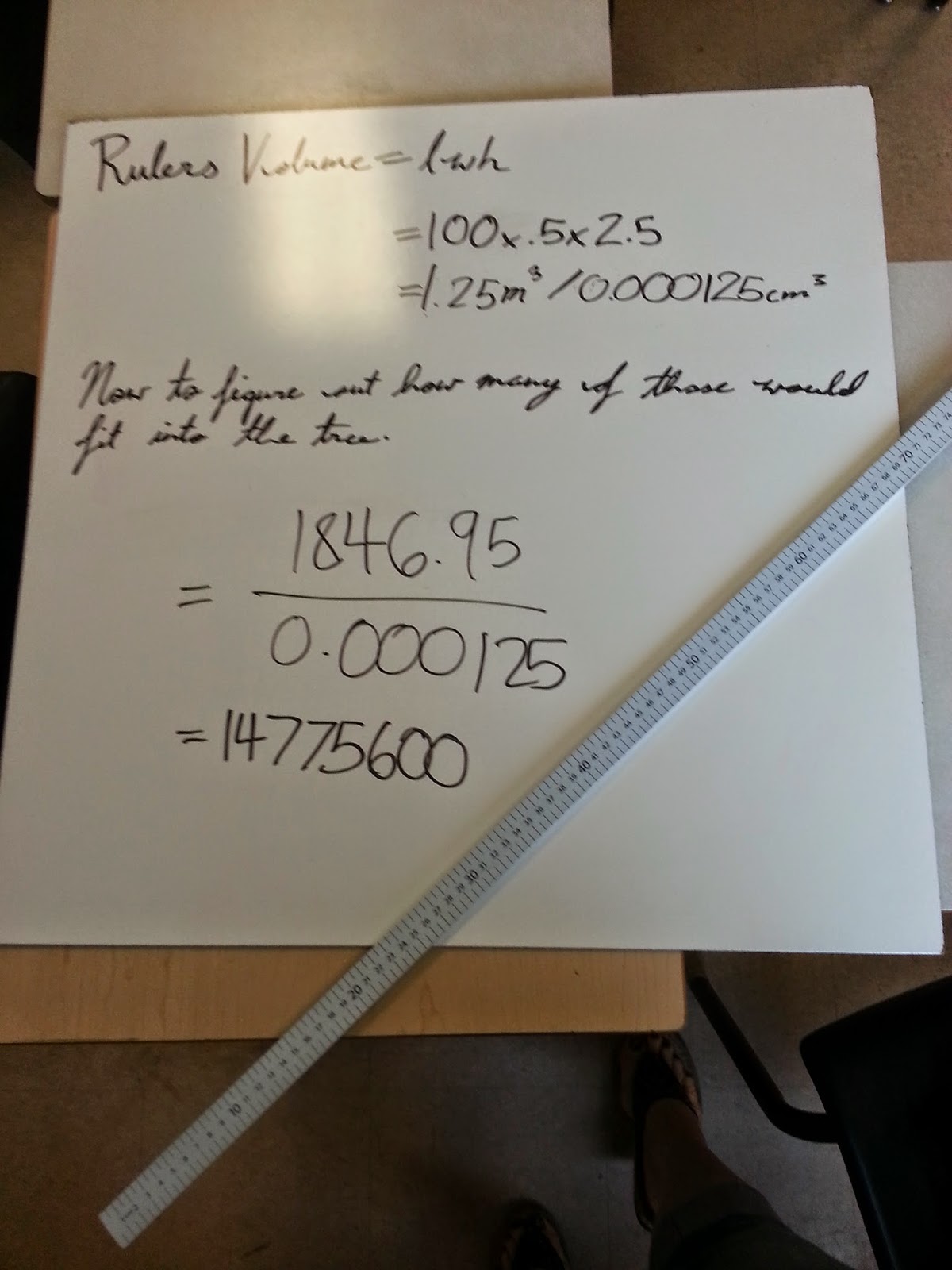
I asked which of the questions they now wanted to answer. They settled on "How much firewood?" as it seemed more manageable than the "How many toothpicks?" question. They estimated the size of the log (they are so confident doing this thanks to Estimation 180), first in feet then decided they needed to work in metres. I brought over a metre stick to help them visualize. Their calculations are above. They struggled making sense of their answer for the volume of 1 log, as it was in m^3. I love that they do think about whether an answer seems reasonable.

(My sequel looked like this... but I went with what they were interested in finding out instead.)


I then asked them each to calculate how many of something they could make from this tree. Here are some of the results:

Number of sheets of paper: 

Number of metre sticks:

Number of toothpicks:


At this point the school went into "safe school" mode which means that no one is allowed out of class. The Tournament of Champion players were all around the hallways so I ushered a number of them into my classroom. They joined in on the tree questions and added a few to our list:
- How many people would it take to link arms around the tree?
- How many people would it take to touch the top of the tree?
- Using the average height of its surrounding trees, how many trees would it take to reach the top?
-What is the % chance of the tree being the coolest tree fort ever?

I love that the older students who came in to our class joined in and valued what my students were doing. I love that they came up with a lot of the same questions that my gang had come up with, but not all of them. I was really proud of my little class today - they did great work.