Today's warm up is our first math talk. And I'm not there : ( They will be doing 12 x 15 without a calculator. I want to see as many strategies as possible. I am always amazed at how many kids will actually draw 12 groups of 15 dots of 15 groups of 12 dots and either count or add up the result. I was sure I had a picture from a previous class that had done this math talk, but I can't find one. Here are some of the strategies that I might see:
My students always come up with ones that I don't think of, which is the beauty of doing math talks. All students see that there are multiple ways of getting to an answer. Regardless of whether you are the top student or one who is struggling, you found a way and can learn from others. If you are not familiar with math talks, you might want to check out Jo Boaler's work and the YouCubed website.
As I didn't know quite how far my students would get in my absence yesterday, I left some really boring worksheets for them to practice calculating surface area and volume of prisms and cylinders. As much as I like to keep my students engaged and don't think these worksheets will necessarily do that, I think some will need the practice and my substitute teacher will need something concrete for them to work on. Working with triangular prisms is especially tricky for many of my students so this will hopefully help them work out the kinks in their thinking.
I also left them this 3-act to work on.
I hope I am "tricking" them into remembering that the sides of a cylinder come from a rectangle while doing some hands-on work. Thank you, Dan Meyer, for again helping me make my class better.
I am at a math conference today through Sunday so today's and tomorrow's blog posts are what should be happening in my class in my absence. I suspect reality will be somewhat different!
Today's warm up is this Would You Rather:
I happily let my students use their phones to find out the mass of a penny (hmmm, we don't have pennies in Canada anymore) and the mass of a quarter. I suspect that some groups will work with the mass of American coins (because when they Google it that may come up first if the word Canadian is not in there) while others will have Canadian coin masses which will be slightly different. So here is what I found:
and then I looked for the Canadian equivalent and this is what I found.
For the penny:
For the quarter:
Whoa! Look at the mass of a penny from 1908 to 1920. There is some interesting data in here that would likely had led me on a tangent with my class (!). I love that both the US Mint and Canadian mint list the masses in grams and that the Would You Rather is in pounds. Students need to do some conversions in context and make sense of their answers. Wish I had some student work to show.
After the warm up they will work on yesterday's handout some more. I hope they will realize that the volume of a prism and a cylinder is the area of the base multiplied by the height. Having them estimate first, with actual blocks or pictures of blocks, should help them see the layers.
They will spend the last part of class doing Andrew Stadel's File Cabinet 3-act activity.
I love this one and they do too.
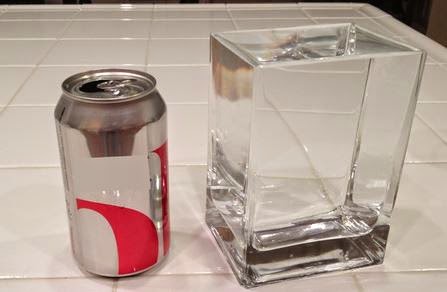
Some of my students finished their test yesterday, but many didn't, so they continued today. Those who had finished worked on the warm ups from yesterday and today. We did this Estimation 180 as it ties in with what we will be doing for the next few days.
One of my students got it exactly right. He said that he thought the vase was about double the volume of the can. Not having done the previous Estimation 180s, he assumed the volume of the can was 355 ml, as is the case in Canada. In the US, the volume is 370 ml. It's ironic that had he known the actual volume of the can shown, he would not have gotten the correct volume of the vase.
The 2nd warm up was this Visual Pattern:
Most got the rule, but some are still having trouble explaining how they got it. Here is what we did with it:
By this time only a couple of students were still working on their test (one was away yesterday) so we moved on to this handout.
Students were building rectangular prisms with linking cubes where the dimensions were randomly determined by rolling a die. They had to calculate volume and surface area.
Many students did not know how to build their prism once they had their dimensions. This reinforced the need to have them build. I circulated and helped them understand how to build their prism, what volume represented (number of cubes) and how to calculate it based on the dimensions of the prism. Some knew how to find surface area, but many did not know where to start but having the physical model in front of them made it really simple to explain it to them.
They will continue tomorrow and add cylinders and triangular prisms to the mix.