As many of my students were away on a field trip on Friday I told them to each find someone who was in class, and have them explain completing the square. They spent about 15 minutes on this. I thought it would be a good way to bring those who had missed class up to speed, but would also be of benefit to those who were there as they had to explain the concept well enough for their classmates to understand.
What we worked on today was really more of the same.
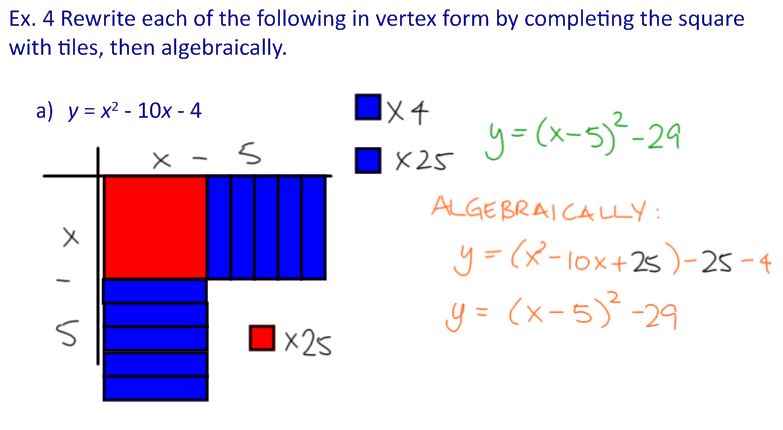
I illustrated the point that we could not make a square with two x^2 tiles. I asked if we could if we have four... they thought a bit and many said yes. What about three? No. Nine? Yes.
I showed them that we divide up the x^2 tiles and create a square for each one, dividing the x tiles evenly among them.
We translated this into a chart method and repeated the process algebraically, too.
We continued with more examples, relying less on the tiles each time yet always tying the process back to them - "Why are we dividing by 2? Why are we squaring?".
When we looked at the next example, using tiles or the chart became less meaningful as it's hard to think of having -3 of each square. I think they had enough experience and a solid enough understanding of why we were doing what we were doing to move to the algebraic form.
I will post today's homework tomorrow as DropBox is not cooperating right now.
Showing posts with label completing the square.. Show all posts
Monday, 7 December 2015
Friday, 4 December 2015
MPM2D - Day 60: Completing the Square, Day 1
We started today by looking for patterns in perfect square trinomials.
They noticed the pattern which we consolidated:
Then we looked at it another way. In groups of four, they each answered one of these questions and then wrote the sum of the four answers in the middle box. This allows me to quickly see if they are correct and, if they are not, they have to work together to figure out which question(s) are wrong.
We talked about how we can find the vertex of a parabola. Factor the quadratic, take the average of the zeros, then substitute that value back in the equation. But what if you can't factor the quadratic? One student said he could always find the zeros... "Desmos!", he said :) Then the algebra tiles came out and we starting completing the square.
The idea of making a square is not difficult when they work with the tiles. We kept the 7 unit tiles off to the side and then added one positive unit tile to fill in the square. This meant that we also needed to add one negative unit tile to ensure that we weren't changing the value of expression. Writing the equation in vertex form was quite straightforward, as was stating the vertex.
I gave them the steps - this may be useful for those students who were away today.
Then we practiced some more.
It was time to start to move toward an algebraic solution so we started by noticing what is happening with the numbers, and then repeated one of the previous examples without tiles.
We did a few more examples.
Along the way we talked about why we needed to move away from the tiles. What if the number of x-tiles was not even? But we did a simple case together with tiles - not the actual tiles though, as I do not want them split in half!
Today's homework was to go back over any old homework that they had either not completed or done incorrectly. Next class we will look at cases where the a-value is not 1.
Subscribe to:
Posts (Atom)