I ended my first full unit teaching in a Thinking Classroom (you can read about the beginning of this journey for me here) in my calculus classes just before the March break. I surveyed my students and had mixed feelings about the results. Many suggested 20 minutes of notes at the beginning of class, yet many of these same students also said that they never looked at the notes I post on Google classroom each day. I e-mailed Alex Overwijk to ask for advice, saying that I felt like I was doing something wrong, or at least not entirely right. His response went along the lines of "they don't like being uncomfortable, they don't like having to struggle and you aren't doing anything wrong". I think that what led to me feeling as I did had a lot to do with the very skill-based nature of the unit. They were taking derivatives and taking more derivatives and then they took some more derivatives. This led to groups taking turns doing questions. The questions were not challenging enough to require them to work together as a group to solve them. I'm not sure how to change that for the let's-learn-how-to-take-derivatives unit, but I will ponder that some more before we get there again next year.
This past week we have been working on the elements of curve sketching. Using the first and second derivatives to help determine intervals of increase and decrease, local maximum and minimum points, intervals of concavity, points of inflection, etc. I have continued to use visible random groups and they have continued to work on the VNPS (whiteboard/chalkboard) for almost the entire class each day. I have tried to be more intentional about what I do work through with them - mostly at the beginning of the class. The questions have been more interesting and more challenging for them. I am really pleased with their efforts. I am finding that they are putting all the pieces together more easily and that I am also thinking more deeply about the material. And it's fun! At least twice this week the bell rang at the end of my afternoon class without anyone in the room being aware that it was the end of class. They didn't want to stop. It's incredible how much fantastic work they are producing and how well they can explain it all to me. I am not quite sure how much gushing is appropriate, but my students are awesome. I snapped this picture of some of them this morning and it makes me happy and proud to look at it.
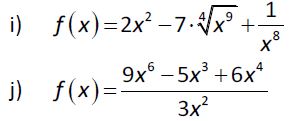
Here is the progression I used for the week (apologies - I got lazy and didn't include all the answers). They did not all get through every question yesterday and today, but I believe that they all have a solid grasp of the material. I continue to post filled-in notes at the end of each day should they wish to review the work or try any of the questions on their own.
Showing posts with label MCV4U. Show all posts
Friday, 24 March 2017
Wednesday, 1 March 2017
Quotient Rule in a Thinking Classroom
I learned a lesson yesterday when my students far exceeded my expectations. One group had completed the entire sequence I came up with to "discover" and apply the quotient rule within 30 minutes of the start of class. This is when I am really glad that I have taught the course many times before and know the material inside out. I let that group start on their homework, something that never really happened during class time even before I switched to a the thinking classroom model, while I found another question worthy of their time. I could have just thrown an uglier question up on the board for them, but I wanted one that would make them think and, hopefully, challenge them. I found a good one and they got back up and worked at it for most of the remainder of the class.
The challenge for me is to set up my sequence of questions in a very intentional way, making sure the progression is neither too little nor too much at a time. But I also have to make sure that I have planned enough challenges to keep them going and keep them thinking. Getting that right will take a little more practice.
After that class I fixed things up for my afternoon class, adding the new question into the sequence along with another harder question that would make any algebraic misconceptions come to light. It turned out to be a little too tricky for most groups and they all got stuck. I adjusted by giving them the answer so they knew what they were trying to get, but many groups eventually abandoned that question and moved on. After that class I rearranged my sequence again, putting that question last.
As I learn to adjust and plan better hopefully I will get better at finding that sweet spot of just-right difficulty progression and quantity.
The challenge for me is to set up my sequence of questions in a very intentional way, making sure the progression is neither too little nor too much at a time. But I also have to make sure that I have planned enough challenges to keep them going and keep them thinking. Getting that right will take a little more practice.
After that class I fixed things up for my afternoon class, adding the new question into the sequence along with another harder question that would make any algebraic misconceptions come to light. It turned out to be a little too tricky for most groups and they all got stuck. I adjusted by giving them the answer so they knew what they were trying to get, but many groups eventually abandoned that question and moved on. After that class I rearranged my sequence again, putting that question last.
As I learn to adjust and plan better hopefully I will get better at finding that sweet spot of just-right difficulty progression and quantity.
Monday, 27 February 2017
Product Rule in a Thinking Classroom
Today was day 3 of running my classroom as a thinking classroom - visible random groups (of 3) working on vertical non-permanent surfaces. We started with a quick demonstration to show that the derivative of a product is not the product of the derivatives. Students then worked through a product rule "discovery" activity that I have been using for years. You can find it here. I wish I could give proper credit for it, but I do not remember who shared it with me.
Here is the setup:
Their job was to work with the numbers they came up with in the table to figure out a pattern that worked for each row - that would be the product rule.
It is always interesting to see who comes up with it quickly and who takes a little longer (often because they are trying really complicated things!).
Once I felt like the majority of students had found the pattern, I sent them off to their VNPS to work through today's sequence of questions.
The last of these asked them to come up with the product rule for three terms. I loved what some of the groups did. They extended the introductory activity to 3-D, added height and worked through the numbers again! (sorry that the picture quality is terrible)
Here's a group that came up with a conjecture for the product rule with three terms and tested it out. I would like to say they did this instead of asking me if they were right, but they did jump right to it when I said they should check it for themselves.
It was really exciting to see such fantastic work, at such a high level from all my students. I love how they trust that they will be able to tackle all the questions I give them and believe in themselves enough to try.
P.S. All of my planning is on one getting-bigger-by-the-day Word document. I'll post the whole thing at the end of the unit.
Here is the setup:
Students worked out expressions for length, width and area and for their rates of change before completing the following table.
It is always interesting to see who comes up with it quickly and who takes a little longer (often because they are trying really complicated things!).
Once I felt like the majority of students had found the pattern, I sent them off to their VNPS to work through today's sequence of questions.
The last of these asked them to come up with the product rule for three terms. I loved what some of the groups did. They extended the introductory activity to 3-D, added height and worked through the numbers again! (sorry that the picture quality is terrible)
Here's a group that came up with a conjecture for the product rule with three terms and tested it out. I would like to say they did this instead of asking me if they were right, but they did jump right to it when I said they should check it for themselves.
It was really exciting to see such fantastic work, at such a high level from all my students. I love how they trust that they will be able to tackle all the questions I give them and believe in themselves enough to try.
P.S. All of my planning is on one getting-bigger-by-the-day Word document. I'll post the whole thing at the end of the unit.
Thursday, 23 February 2017
Thinking Classroom - Day 1
After last week's workshop with Peter Liljedahl I decided to go full-on thinking classroom in both my calculus classes. I told them that they wouldn't be taking notes today and that they would be working in groups at the boards around the room. We talked a little about what the derivative function is and how we find it, along with the issues that would arise if they tried to find the derivative of y = x^729 from first principles. Next they each chose a card to determine their group. Off they went to their whiteboards/chalkboards and they started on the first question. Even though many had already been told the power rule, I made them "convince me" (and themselves) by finding each derivative from first principles. Here is the order of the questions they did:
They noticed patterns in parts (a) and (b) and were able to explain why the derivatives of (c) and (d) were the same as (a). Part (e) went better than expected and generally confirmed their conjectures. The results from parts (f) and (g) were confusing for many and I found that it was helpful to rewrite the question and get them to write the answer in the same form in order for them to see the pattern still held. They got stuck trying to do part (h) from first principles so needed to find the derivative another way.
At this point we stated the power rule as a group and turned to proving it. In the past, I have gone through the proof with my classes and many students' eyes have glazed over as they completely tuned me out. This time I gave them the expansion of x^n - a^n, we talked about how many terms there would be in part of it and let them try the proof. At least one group in each class finished the proof on their own! And all groups made good headway with it which helped them stay engaged when I showed them the full thing. I think they thought it was kind of cool!
I gave them two more questions after the proof:
The first was no problem and the second was done incorrectly by almost 100% of groups. We stopped there for today and I asked them to write down a summary of what they had learned. I didn't do anything else to close the lesson as I felt like it wasn't needed.
Here is the sequence for tomorrow:
Overall I thought today went well. I have done enough of this type of work with students that I was very comfortable and my students were great. There were a few times when I took a marker (there was only one marker/piece of chalk for each group) and handed it to a particular student, but in general they took turns doing the questions. Those not writing the solutions were watching what was going on, looking for errors. There were some good discussions going on today, but I anticipate more tomorrow due to the nature of the questions. There were some groups that would call me over to check their work, but they got a lot of "What do you think?" and "Convince me" and "Are you sure?" so I suspect that will diminish as we continue. I had to ask a few students to put their phones away, but it was not really an issue. They all did math and were all thinking and even those who came in knowing the power rule learned something new.
They noticed patterns in parts (a) and (b) and were able to explain why the derivatives of (c) and (d) were the same as (a). Part (e) went better than expected and generally confirmed their conjectures. The results from parts (f) and (g) were confusing for many and I found that it was helpful to rewrite the question and get them to write the answer in the same form in order for them to see the pattern still held. They got stuck trying to do part (h) from first principles so needed to find the derivative another way.
At this point we stated the power rule as a group and turned to proving it. In the past, I have gone through the proof with my classes and many students' eyes have glazed over as they completely tuned me out. This time I gave them the expansion of x^n - a^n, we talked about how many terms there would be in part of it and let them try the proof. At least one group in each class finished the proof on their own! And all groups made good headway with it which helped them stay engaged when I showed them the full thing. I think they thought it was kind of cool!
I gave them two more questions after the proof:
The first was no problem and the second was done incorrectly by almost 100% of groups. We stopped there for today and I asked them to write down a summary of what they had learned. I didn't do anything else to close the lesson as I felt like it wasn't needed.
Here is the sequence for tomorrow:
Overall I thought today went well. I have done enough of this type of work with students that I was very comfortable and my students were great. There were a few times when I took a marker (there was only one marker/piece of chalk for each group) and handed it to a particular student, but in general they took turns doing the questions. Those not writing the solutions were watching what was going on, looking for errors. There were some good discussions going on today, but I anticipate more tomorrow due to the nature of the questions. There were some groups that would call me over to check their work, but they got a lot of "What do you think?" and "Convince me" and "Are you sure?" so I suspect that will diminish as we continue. I had to ask a few students to put their phones away, but it was not really an issue. They all did math and were all thinking and even those who came in knowing the power rule learned something new.
Wednesday, 1 June 2016
What's Your Best Question?
Yesterday, before class, I tweeted this out:
And, as usual, the #MTBoS came through. Here are just some of the replies I received:
I answered the question thanks to the great replies I got. But it was not until a student asked me how to solve the question that I realized that, despite knowing that many students would struggle with this question, I did not plan out what I would say when they asked for help. My answers ended up being just like those given to me on Twitter - "this is how you start it" which really took some of the fun out of solving this "puzzle". So I am now wondering what a good question would be to help move my students' thinking forward without giving away the solution. I should have at least asked "What do you notice?", but am not sure that would have been enough to get them going. Please tell me if I am wrong! This is the question I came up with in the van ride to take my kids to Jiu-Jitsu:
I am wondering what you would ask - what would your best question be? Please let me know in the comments!
And, as usual, the #MTBoS came through. Here are just some of the replies I received:
I answered the question thanks to the great replies I got. But it was not until a student asked me how to solve the question that I realized that, despite knowing that many students would struggle with this question, I did not plan out what I would say when they asked for help. My answers ended up being just like those given to me on Twitter - "this is how you start it" which really took some of the fun out of solving this "puzzle". So I am now wondering what a good question would be to help move my students' thinking forward without giving away the solution. I should have at least asked "What do you notice?", but am not sure that would have been enough to get them going. Please tell me if I am wrong! This is the question I came up with in the van ride to take my kids to Jiu-Jitsu:
I am wondering what you would ask - what would your best question be? Please let me know in the comments!
Monday, 22 February 2016
The Power of Popsicle Sticks
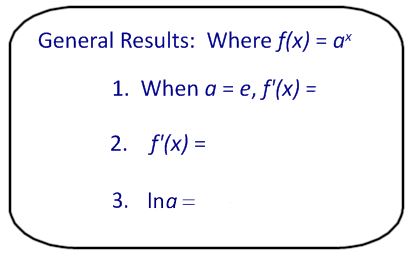
Content is not important to this post, but it sets the context. We looked at derivatives of exponential functions on Friday, starting with the derivative of y = ex. We do this by looking at values of f(x) and f'(x) and then calculating the ratio of f'(x) to f(x). Today, we explored finding derivatives of exponential functions from first principles. I therefore didn't think there would be any issues when I asked them all to complete this:
And I might not have known that this was neither clear nor obvious had it not been for Popsicle sticks.
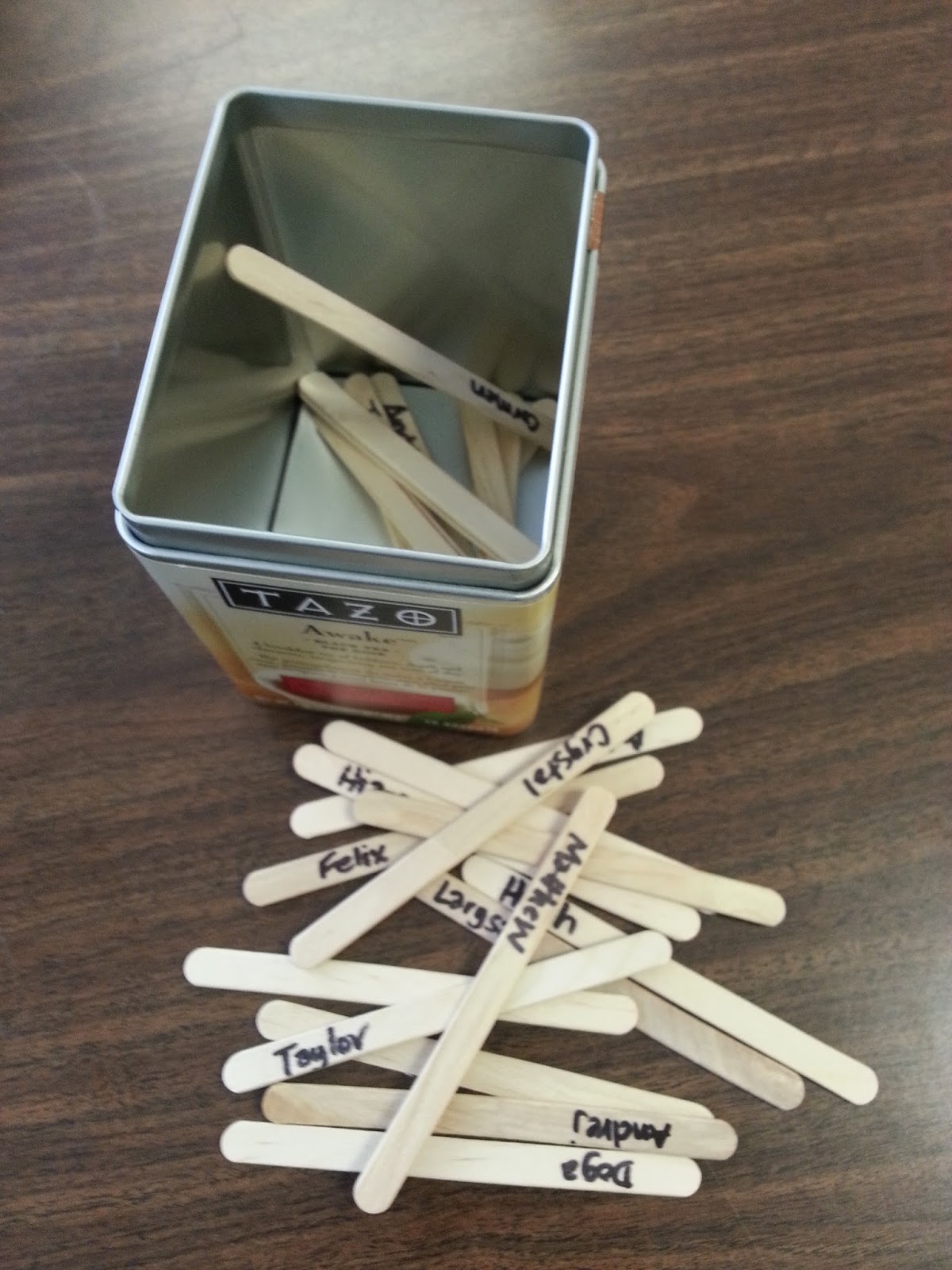
This is my tin of Popsicle sticks for my morning class. I have one for each of my afternoon classes as well. I generally go with the "no hands up except to ask a question" rule which means that the one or two extroverts in the class who have all the answers are not the only voices heard. I choose a name randomly to answer a question and then quite often choose another name to add thoughts to the first response. A response of "I don't know" is okay and is often followed by several other "I don't know"s which tells me that we all need to take a step back.
This morning's Popsicle sticks told me a lot. I went through a lot of sticks - there was a huge pile outside the tin - which means that there were many answers (some right, some not) to my questions and much "What do you think?" from me as I chose another name following each answer. When this happen I have them talk in their groups to see if they can make connections together before trying again.
The Popsicle sticks help make my classroom a learning space where everyone has a voice and every voice is important. I do my utmost to make it a safe place where making mistakes is not only okay, but important. In addition to that, Popsicle sticks help me be a better teacher. They help me gauge the understanding in the room (I do thumbs up-sideways-down a lot, also) and help adjust the pace and choose what we need to practice in the moment. This is still a work in progress for me, but one that I think is important to help me grow as a teacher and to ensure that my students truly understand what we are doing, not merely mimic completed examples.
I first read about using Popsicle sticks in Dylan Wiliam's Embedded Formative Assessment. Here is a video about this strategy and here is his website.
And I might not have known that this was neither clear nor obvious had it not been for Popsicle sticks.
This is my tin of Popsicle sticks for my morning class. I have one for each of my afternoon classes as well. I generally go with the "no hands up except to ask a question" rule which means that the one or two extroverts in the class who have all the answers are not the only voices heard. I choose a name randomly to answer a question and then quite often choose another name to add thoughts to the first response. A response of "I don't know" is okay and is often followed by several other "I don't know"s which tells me that we all need to take a step back.
This morning's Popsicle sticks told me a lot. I went through a lot of sticks - there was a huge pile outside the tin - which means that there were many answers (some right, some not) to my questions and much "What do you think?" from me as I chose another name following each answer. When this happen I have them talk in their groups to see if they can make connections together before trying again.
The Popsicle sticks help make my classroom a learning space where everyone has a voice and every voice is important. I do my utmost to make it a safe place where making mistakes is not only okay, but important. In addition to that, Popsicle sticks help me be a better teacher. They help me gauge the understanding in the room (I do thumbs up-sideways-down a lot, also) and help adjust the pace and choose what we need to practice in the moment. This is still a work in progress for me, but one that I think is important to help me grow as a teacher and to ensure that my students truly understand what we are doing, not merely mimic completed examples.
I first read about using Popsicle sticks in Dylan Wiliam's Embedded Formative Assessment. Here is a video about this strategy and here is his website.
Saturday, 20 February 2016
Log Clothesline - My Post-Activity Post
Yesterday, I ran the log clothesline activity with two of my classes.
What I liked:
What I would change:
What I liked:
- The great math conversations. They had not worked with logs for a while now, so some remembered a lot and some, well, not so much. They were talking to each other about how to get going with tricky expressions at their desks initially and the conversations continued when they were at the clothesline trying to place the cards in the correct order.
- The collaboration. Those who couldn't even remember how to go from logarithmic form to exponential form got help in their groups. They asked each other questions, they checked each other's work and argued about who was right.
- The struggles. Apart from the one card with a typo (oops!), all of the others worked out. However, I made this a no calculator activity (horror!) so they had to work smarter to reduce the amount of arithmetic required. Those log rules really became useful.
What I would change:
- I found this activity worked much more smoothly with my smaller afternoon class. I only had 13 students in that class yesterday and everyone was engaged and busy. My morning class, which had 24 students, had more "traffic jams" around the clothesline causing other students to step away and no longer be engaged in the activity. I would put up two clotheslines for a larger class next time.
- I also liked having extra cards in my afternoon class for those who finished quickly, so I would make more cards next time or have two sets for a larger class.
- The change that would have the biggest impact, I believe, is adding more number markers to the line. I had a 0 marker, but the struggle to correctly arrange all the expressions on the line was greater than I had planned. I asked my afternoon class if they thought having more number markers would help, and they unanimously said yes! I loved that some were using the small whiteboards to work out the expressions from other students' cards that were already on the line, but it became overwhelming.
I definitely think this activity was worth doing and that all students got something out of it. Here is the final clothesline:
Wednesday, 17 February 2016
Log Clothesline
There has been quite the buzz around clothesline activities of late. There is even a clotheslinemath.com website! I first heard about it from Andrew Stadel when he wrote this post. More recently, Jon Orr made a cool one to practice finding slope. Here is a link to his blog post. I thought that it would be great to use a clothesline to practice evaluating logs, but was having trouble finding the time to actually create it. Then we got a snow day (school buses are cancelled, but teachers still have to report to work... all of the students at my school take the bus so we have a day with no students) but I had other things to do (like meetings) and we were allowed to go home early (we got 51.2 cm of snow by the end of the day!). And then, shockingly, they cancelled the buses again today! So here is the log clothesline for you. I plan on actually doing it with my two MCV4U classes on Friday and and will snap some pictures then. I did take a "fake" one of a colleague placing a card on the clothesline.
Here is the Word file, and the PDF version is here. And I'll even give you the answers. I numbered the pages so those correspond to the question numbers, which I have sorted in the Excel file so that I can quickly check for correctness. I printed two pages per sheet and cut them down the middle.
I will give out one card to each student and they will have to evaluate their expression and check at least one from someone else in their group. Once the whole group is confident in their answers, they will go to the clothesline to place their expression in the correct location. I will give them a 0 marker on the number (clothes)line. The trick is that I will tell them that they can't write on the cards so in order to figure out where their card goes, they will have to work out a number of other expressions. Those students who put their cards up first will be responsible for ensuring that all the cards that follow are in the right place.
I will try to write a "how it went" blog post after I run the activity.
Postscript
After hitting publish this morning I started to think more about this activity and started questioning whether it met the spirit of clothesline activities. I worried that as it doesn't really work students' number sense, it might not be an activity worthy of sharing. I sought advice and, though we agreed this would be better suited to an intro to logs activity (more on that in a minute), this practice, with built-in error analysis and collaboration, was worth sharing.
Back to the intro to logs idea. This is what I envision: students get cards with powers of 2s from 1/64 to 32768 (or something like that, depending on the number of students in the class) and they have to attempt to place them on a clothesline that will have markers of 0 and 1 on it (not as shown below). It would look something like this:
Hopefully it will become clear that there are too many cards between 0 and 1 and that the larger numbers simply cannot fit on the clothesline. So what to do? I'm not sure how to introduce the idea of taking log base 2 of each of the numbers, but that will be the goal. The result will be a clothesline with a logarithmic scale which will allow all the numbers to be seen. I won't actually be able to do this until next fall, so please let me know if you try it out!
Here is the Word file, and the PDF version is here. And I'll even give you the answers. I numbered the pages so those correspond to the question numbers, which I have sorted in the Excel file so that I can quickly check for correctness. I printed two pages per sheet and cut them down the middle.
I will give out one card to each student and they will have to evaluate their expression and check at least one from someone else in their group. Once the whole group is confident in their answers, they will go to the clothesline to place their expression in the correct location. I will give them a 0 marker on the number (clothes)line. The trick is that I will tell them that they can't write on the cards so in order to figure out where their card goes, they will have to work out a number of other expressions. Those students who put their cards up first will be responsible for ensuring that all the cards that follow are in the right place.
I will try to write a "how it went" blog post after I run the activity.
Postscript
After hitting publish this morning I started to think more about this activity and started questioning whether it met the spirit of clothesline activities. I worried that as it doesn't really work students' number sense, it might not be an activity worthy of sharing. I sought advice and, though we agreed this would be better suited to an intro to logs activity (more on that in a minute), this practice, with built-in error analysis and collaboration, was worth sharing.
Back to the intro to logs idea. This is what I envision: students get cards with powers of 2s from 1/64 to 32768 (or something like that, depending on the number of students in the class) and they have to attempt to place them on a clothesline that will have markers of 0 and 1 on it (not as shown below). It would look something like this:
Hopefully it will become clear that there are too many cards between 0 and 1 and that the larger numbers simply cannot fit on the clothesline. So what to do? I'm not sure how to introduce the idea of taking log base 2 of each of the numbers, but that will be the goal. The result will be a clothesline with a logarithmic scale which will allow all the numbers to be seen. I won't actually be able to do this until next fall, so please let me know if you try it out!
Thursday, 4 February 2016
Small Changes
I have taught this weird grade 12 course we have in Ontario called Calculus & Vectors forever (well, since it was introduced) so I could just walk in each day and teach based on what I did last year. There are certainly days when that is exactly what will happen, but I am trying to tweak lessons as I go through. I have a little more time to do this as I am not revamping an entire course the way I did last semester.
Day 1: I really liked the Desmos activity I created last year so I turned it into an Activity Builder activity - here is the link. I loved being able to see what equations my students were trying so that I could give meaningful feedback if they were on the wrong path. There was a lot of good mathematical talk going on as well as some struggle which some students are clearly not used to. Many expected me to just tell them the answer when they got stuck. I did not.
Day 2: School buses were cancelled due to wicked freezing rain (the roads literally had a sheet of ice on them). Our schools never close so I had to report, but as all of our students take the bus in, I had a day without students.
Day 3: Limits. We don't spend a lot of time on limits, but I think there is value in understanding what a limit is as we head toward derivatives. In the past I have done a demonstration simulating the amount of medicine in your body using a pitcher of water and some food colouring. I have also talked about Archimedes, but switched things up this year. I let my students be Archimedes (only with calculators!) and paired them up to find the area of a regular polygon. As a class they chose a radius and we talked briefly about "apothem", a word they had never come across before.
This is what we ended up with:
Those blanks are groups that just didn't get there. This wasn't as obvious as you might think as they haven't done any work with polygons since grade 9. The area for the nonagon was erased when the group saw that an area of around 110 was not following the trend. I took a little time to ask them how they had found the area and was pleased at the number of different approaches they used to find the side length of the polygon. When I asked what they noticed they said the numbers were increasing. I asked how they were increasing and then what they might be approaching. One student guessed 80 or maybe 78. Another went straight to the area of a circle. (I don't yet know who not to call upon!)
Then we talked about Archimedes before defining a limit.
At this point they had a rough idea of what a limit was and a definition, but that doesn't necessarily translate into being able to find a limit. In past years I have given them the graph below along with 12 limits for them to find. It seemed to go well, but there were always some students who clearly had not understood any of it. So I changed my approach and projected the graph for them and asked them to write the value of the limit I said aloud on their little whiteboard. Just the number. Write it down then everyone holds up their whiteboards facing me so that I can see how they are doing. It was so good! I first asked for the limit as x approached -6 from the left. The class was pretty much split between -2 and 2.5, with a few not wanting to write anything down. I didn't say anything about their answers, instead I moved on and asked them the limit as x approached -6 from the right. The class unanimously wrote 2.5. Then we talked about both of these limits before I asked for the limit as x approached -6. Hmmm. Some wrote both previous answers, some wrote only one of them, some averaged them, some said IDK. This provided the opportunity for good discussion and reflection. We moved on to looking at the limit as x approached 5. There was even a "what if we..." question that segued into looking at the limit as x approached -1. Yes!
Then I handed out the same graph with those 12 limits we have always found and they did them without hesitation. We answered questions together and they really seemed to get it.
Next, we looked at limits of various functions given their equations. Everything was tied back to the graphs. We visualized what the graph was doing as we approached whatever value. I probably asked "Is there anything weird going on?" too many times, but I think it helps them think about whether the is a discontinuity and whether that impacts the limit.
As you have gotten this far, thanks for reading my blog. I was pumped coming out of that class and wanted to blog about it. It is strange to not blog every day!
Day 1: I really liked the Desmos activity I created last year so I turned it into an Activity Builder activity - here is the link. I loved being able to see what equations my students were trying so that I could give meaningful feedback if they were on the wrong path. There was a lot of good mathematical talk going on as well as some struggle which some students are clearly not used to. Many expected me to just tell them the answer when they got stuck. I did not.
Day 2: School buses were cancelled due to wicked freezing rain (the roads literally had a sheet of ice on them). Our schools never close so I had to report, but as all of our students take the bus in, I had a day without students.
Day 3: Limits. We don't spend a lot of time on limits, but I think there is value in understanding what a limit is as we head toward derivatives. In the past I have done a demonstration simulating the amount of medicine in your body using a pitcher of water and some food colouring. I have also talked about Archimedes, but switched things up this year. I let my students be Archimedes (only with calculators!) and paired them up to find the area of a regular polygon. As a class they chose a radius and we talked briefly about "apothem", a word they had never come across before.
This is what we ended up with:
Those blanks are groups that just didn't get there. This wasn't as obvious as you might think as they haven't done any work with polygons since grade 9. The area for the nonagon was erased when the group saw that an area of around 110 was not following the trend. I took a little time to ask them how they had found the area and was pleased at the number of different approaches they used to find the side length of the polygon. When I asked what they noticed they said the numbers were increasing. I asked how they were increasing and then what they might be approaching. One student guessed 80 or maybe 78. Another went straight to the area of a circle. (I don't yet know who not to call upon!)
Then we talked about Archimedes before defining a limit.
At this point they had a rough idea of what a limit was and a definition, but that doesn't necessarily translate into being able to find a limit. In past years I have given them the graph below along with 12 limits for them to find. It seemed to go well, but there were always some students who clearly had not understood any of it. So I changed my approach and projected the graph for them and asked them to write the value of the limit I said aloud on their little whiteboard. Just the number. Write it down then everyone holds up their whiteboards facing me so that I can see how they are doing. It was so good! I first asked for the limit as x approached -6 from the left. The class was pretty much split between -2 and 2.5, with a few not wanting to write anything down. I didn't say anything about their answers, instead I moved on and asked them the limit as x approached -6 from the right. The class unanimously wrote 2.5. Then we talked about both of these limits before I asked for the limit as x approached -6. Hmmm. Some wrote both previous answers, some wrote only one of them, some averaged them, some said IDK. This provided the opportunity for good discussion and reflection. We moved on to looking at the limit as x approached 5. There was even a "what if we..." question that segued into looking at the limit as x approached -1. Yes!
Then I handed out the same graph with those 12 limits we have always found and they did them without hesitation. We answered questions together and they really seemed to get it.
Next, we looked at limits of various functions given their equations. Everything was tied back to the graphs. We visualized what the graph was doing as we approached whatever value. I probably asked "Is there anything weird going on?" too many times, but I think it helps them think about whether the is a discontinuity and whether that impacts the limit.
As you have gotten this far, thanks for reading my blog. I was pumped coming out of that class and wanted to blog about it. It is strange to not blog every day!
Tuesday, 19 May 2015
MFM2P - Day 67: Trig Matching
It seems like a long time since we have done an Estimation 180. This is today's:
And here are their estimates:
As you can see a few students changed their estimates along the way (I love that they are thinking about it!). We discussed the factors involved (oops, I misspelled marshmallow) including the number of layers of marshmallows and the number of marshmallows per layer. We talked about the "melty" factor, too. This would be a fun one to actually do with a class.
When I corrected their cycle 3 tests I noticed that many students were still struggling with trigonometry and quadratics. So this week is going to be devoted to trig. Well, yesterday was a holiday and I lose my class to an assembly tomorrow, so that's only 3 days of trig. I made up a warm-up, matching activity and extension over the weekend - you can find them here. My inspiration was this post by Tina Palmer.
I handed out the warm-up and circulated to help them get going. Here is a snapshot of what they look like:
One of the reasons for the warm-up was to get my students to differentiate between similar triangle, trig and Pythagoream theorem questions. Some of them see a triangle and immediately do <choose one from above list> regardless of whether it makes sense. The warm-up really forced them to think about what information they were given and what they were being asked to find. Many were stuck on 2 of the 3 kinds of questions but got through them with a little help. A couple of students took the entire period to get through the sheet, mostly because they were getting distracted... The others all began the matching activity. For this one I made up 10 typical right angle trig word problems along with 10 skeleton diagrams and 10 answers. None, of course, were in the same order. My intent was to immediately stop any of them from reading a question and saying "I don't know what to do." I mean, they never get away with that, but this didn't even give them the option.
I wasn't sure if they would want to cut the pieces out but they all seemed happy to number the questions and match the numbers up on the diagrams page. They didn't get very far with this part today, but will continue next class.
As you can see a few students changed their estimates along the way (I love that they are thinking about it!). We discussed the factors involved (oops, I misspelled marshmallow) including the number of layers of marshmallows and the number of marshmallows per layer. We talked about the "melty" factor, too. This would be a fun one to actually do with a class.
When I corrected their cycle 3 tests I noticed that many students were still struggling with trigonometry and quadratics. So this week is going to be devoted to trig. Well, yesterday was a holiday and I lose my class to an assembly tomorrow, so that's only 3 days of trig. I made up a warm-up, matching activity and extension over the weekend - you can find them here. My inspiration was this post by Tina Palmer.
I handed out the warm-up and circulated to help them get going. Here is a snapshot of what they look like:
One of the reasons for the warm-up was to get my students to differentiate between similar triangle, trig and Pythagoream theorem questions. Some of them see a triangle and immediately do <choose one from above list> regardless of whether it makes sense. The warm-up really forced them to think about what information they were given and what they were being asked to find. Many were stuck on 2 of the 3 kinds of questions but got through them with a little help. A couple of students took the entire period to get through the sheet, mostly because they were getting distracted... The others all began the matching activity. For this one I made up 10 typical right angle trig word problems along with 10 skeleton diagrams and 10 answers. None, of course, were in the same order. My intent was to immediately stop any of them from reading a question and saying "I don't know what to do." I mean, they never get away with that, but this didn't even give them the option.
Monday, 27 April 2015
Vectors: Plotting Points in 3D
In Ontario there is a strange grade 12 course called Calculus & Vectors. The two components are completely separate and we are on day 4 of vectors now. Part of today's work involved plotting points in 3D, which they have never had to do before. I start by getting them make their own set of 3D axes using straws (and tape/pipe cleaners) which they can then use whenever they like.
I have my own made of wood thanks to a fabulous former student.
I had them use their models to plot points (in the air) and then showed them the points plotted on this cool little website found on the Solve My Maths site. They then drew the points by hand.
I really liked this and my students appreciated how it showed the point starting at the origin and moving along each plane.
At the end of the lesson I got them to do this treasure hunt. I told them the treasure was a lollipop and they were (strangely) very motivated by this. They had to use the clues given to determine the location of the treasure (such a fake context!) and they really seemed to enjoy it.
And they also enjoyed their "treasure"!
I have my own made of wood thanks to a fabulous former student.
I had them use their models to plot points (in the air) and then showed them the points plotted on this cool little website found on the Solve My Maths site. They then drew the points by hand.
I really liked this and my students appreciated how it showed the point starting at the origin and moving along each plane.
At the end of the lesson I got them to do this treasure hunt. I told them the treasure was a lollipop and they were (strangely) very motivated by this. They had to use the clues given to determine the location of the treasure (such a fake context!) and they really seemed to enjoy it.
And they also enjoyed their "treasure"!
Wednesday, 28 January 2015
Calculus - Day 1
Update: I turned this into a Desmos Activity Builder which you can find here.
Semester 2 begins on Monday and I want to do something interesting with my 2 calculus & vectors classes. I thought it would be good to have them "play" in Desmos for a class. I want them to have fun but for the work to be meaningful so this is what I came up with, very much in the spirit of Daily Desmos (which I have not contributed to for ages :(). I will randomly pair them up and have them recreate as much as they can of this:
Here is a picture of it in case you can't see the video:
They should all be able to correctly determine the equations of the curves, but the animation will be a much bigger challenge for them. I want them to see what is possible with Desmos, yet still within their reach.
I would love your feedback!
Semester 2 begins on Monday and I want to do something interesting with my 2 calculus & vectors classes. I thought it would be good to have them "play" in Desmos for a class. I want them to have fun but for the work to be meaningful so this is what I came up with, very much in the spirit of Daily Desmos (which I have not contributed to for ages :(). I will randomly pair them up and have them recreate as much as they can of this:
Here is a picture of it in case you can't see the video:
They should all be able to correctly determine the equations of the curves, but the animation will be a much bigger challenge for them. I want them to see what is possible with Desmos, yet still within their reach.
I would love your feedback!
Subscribe to:
Posts (Atom)