
Saturday, 23 November 2013
How Many Each?
After a great day at EdCampOttawa, I came home to a roast chicken dinner (yes, my husband is a great cook) along with roasted veggies. While helping himself to seconds, my 8-year old, Noah, complained that he hadn't gotten enough potatoes. My husband said that he had cut 4 potatoes into 4. The kids quickly figured out that there had been 16 potato slices. I then asked how many we would each get if they were equally distributed among us (us being 6 people). They tried 2 and counted up to 12, then tried 3 and counted up to 18 (in 3s) so they knew it was more than 2 but fewer than 3 pieces each. Noah then said that it wasn't 2 and a half. I asked him how he knew. He got mad at me, screamed that he wasn't doing this anymore and stomped away from the table. So I turned to Jacob, who is 6, and asked him the same question as I had seen him making gestures with his hands that looked like he was figuring it out. He told us that if they each got 2 and a half pieces, that would be 15 pieces. At some point my 10-year old said she had figured it out, but actually managed to not yell out the answer (good job, Isabelle!). So back to Jacob. We went back to knowing it was more than 2 pieces each which he told me would be 12 pieces. I asked how many pieces were left to be divided among us. He said 4. He wanted to give each kid 1 and the adults none, but I said we each had to get the same amount. Then he thought Noah shouldn't get any since he had left the table. With a little encouragement he said we could "chop, chop" the pieces into 3. So how many pieces would that make? 12, he counted. And then he figured that once around the table was 6 so he could around the table another time and we would each get 2 of the cut-up pieces. So 2 and two-thirds each. Just as we were saying this Noah yelled from the next room - 2 and a half and one sixth each! Yes, Noah. Yes :) Then he sat back down and finished eating.


Sunday, 17 November 2013
Completing the Square with Algebra Tiles
There seems to be some interest in how to use algebra tiles in the MTBoS so I thought I would attempt a blog post. I apologize now if I confuse anyone - I don't claim to be an expert, but I do find they help kids make connections.
For years I avoided algebra tiles. It didn't help that one of my previous colleagues told the story of how one of her students managed to choke on a tile! Thankfully, none of my students have done that. Our tiles are red and blue so they all feel the need to look through them as if they are 3D glasses (sigh). The kids get to choose which should be positive and which should be negative. They invariably say red is hot so positive and blue is cold so negative so that is what I am using here.
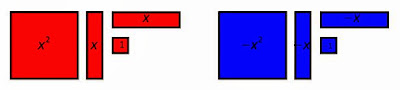 We introduce the tiles in grade 9 when we simplify polynomials. They use them to multiply binomials (it makes a rectangle) and to factor trinomials (find the length and width of the rectangle). So my students are very familiar with algebra tiles by the time they get to completing the square.
I start with a warm-up to make sure they remember what is special about perfect square trinomials. They work in groups of 4 - each student does one question then they add up their answers. If the sum is correct, we can move on, if not, they have to find the error. I stole this from someone at TMC13 (who stole it from someone)^n, who stole it from Kate Nowak.


Students understand that instead of making a rectangle, they need to make a square with their tiles. They each have their own set to work with. We will place the 7 unit tiles off to the side and work with the rest.

They see that they need to add 1 unit tile to make a square. In order to do that we have to add a zero pair so a -1 unit tile goes with the 7 off to the side.
 We can then write the area of the square a its side length squared and simplify the unit tiles. And just like that we have vertex form!
We work through a couple more examples in the same way, with students working with their tiles then consolidating with the whole class. Each time they have to divide the x-tiles - half for the length and half for the width so that they make a square. Each time they have to add unit tiles. I get them to notice patterns in what they are doing.

Next, we use a chart to connect the algebra tiles to the algebra. The cool thing is that they actually understand why we are dividing 'b' by 2 and squaring it because they have done it with the tiles.
The next day we extend to quadratics where 'a' is not equal to 1. Again we start with tiles and connect to algebra. You need identical tile diagrams for each x^2 you have, but it's the same process. It connects factoring out the 'a' value to the tiles.
I find algebra tiles really help explain why we are doing what we are doing. It helps that my students are asking how to change a quadratic from standard form to vertex form. Well, some of them are anyway!
My SMART Notebook file is here. I left off the extra practice for day 2 as I am not really happy with it, but am not sure how to change it.
If you are looking for on-line algebra tiles, The National Library of Virtual Manipulatives is a great resource.
For years I avoided algebra tiles. It didn't help that one of my previous colleagues told the story of how one of her students managed to choke on a tile! Thankfully, none of my students have done that. Our tiles are red and blue so they all feel the need to look through them as if they are 3D glasses (sigh). The kids get to choose which should be positive and which should be negative. They invariably say red is hot so positive and blue is cold so negative so that is what I am using here.

I start with a warm-up to make sure they remember what is special about perfect square trinomials. They work in groups of 4 - each student does one question then they add up their answers. If the sum is correct, we can move on, if not, they have to find the error. I stole this from someone at TMC13 (who stole it from someone)^n, who stole it from Kate Nowak.

Then we tackle our first example:

Students understand that instead of making a rectangle, they need to make a square with their tiles. They each have their own set to work with. We will place the 7 unit tiles off to the side and work with the rest.

They see that they need to add 1 unit tile to make a square. In order to do that we have to add a zero pair so a -1 unit tile goes with the 7 off to the side.

We work through a couple more examples in the same way, with students working with their tiles then consolidating with the whole class. Each time they have to divide the x-tiles - half for the length and half for the width so that they make a square. Each time they have to add unit tiles. I get them to notice patterns in what they are doing.

Next, we use a chart to connect the algebra tiles to the algebra. The cool thing is that they actually understand why we are dividing 'b' by 2 and squaring it because they have done it with the tiles.
The next day we extend to quadratics where 'a' is not equal to 1. Again we start with tiles and connect to algebra. You need identical tile diagrams for each x^2 you have, but it's the same process. It connects factoring out the 'a' value to the tiles.
I find algebra tiles really help explain why we are doing what we are doing. It helps that my students are asking how to change a quadratic from standard form to vertex form. Well, some of them are anyway!
My SMART Notebook file is here. I left off the extra practice for day 2 as I am not really happy with it, but am not sure how to change it.
If you are looking for on-line algebra tiles, The National Library of Virtual Manipulatives is a great resource.
Sunday, 27 October 2013
Working with Integers
How many of us struggle with explaining integers? I know that I do. I find it most difficult to teach topics that are completely obvious to me, that I don't remember ever learning. So integers are right up there. Many years ago my friend, Tom Seidenberg, told me that he used the idea of a hot air balloon and sand bags. I ran with that and have been using it ever since. I am by no means saying that this is the best way to teach integers, but it does give students something concrete to hang on to. I must also say that my students have already been taught about integers, but many did not understand them the first time. This gives students a different way of thinking about integers. It takes a lot more than this to get them comfortable working with integers, but this is how I start.


Introducing Radian Measure
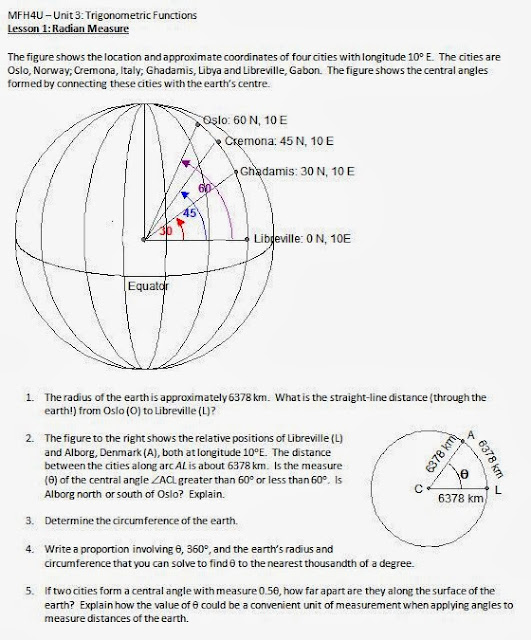
In our curriculum, students learn all about right angle trig and sine and cosine laws in grade 10. In grade 11 they learn about the graphs of trig functions, all done in degrees. In grade 12 they are introduced to radian measure. I was introduced to this by Tom Seidenberg, so I give full credit to him as this may be straight from their materials. I like the way it sets up what 1 radian is and gives a context to arc length over radius.
Link to Word document
Link to Word document

Quadratic Headbanz
My grade 10 academic math class is filled with great kids. For the last week or so we have been exploring quadratics in vertex and factored form, with the help of Desmos. My students are pretty solid at going between equations and their graphs. On Friday, about half of my class was away on a history field trip. We finished some questions from the previous day but I didn't want to start anything new - I wanted to do something fun! At TMC13, Sam Shah organized a Rational Headbanz game for the pre-calc group and I thought I could modify it for quadratics.
With the help of my colleague, Michelle, we made 30 headbanz. We used coloured card stock, cut into rectangles with 2 slits cut along the sides to accommodate ribbon. I wrote the equations and this is how they turned out:

The kids were pretty excited to play. I like to have written instructions on top of what I say, so here is what they saw:

They each got a whiteboard to record their work. It was interesting to see them thinking about what to ask. Many started with "Am I in vertex form?" or "Am I in factored form?" but the poor student who had had a hard time getting good answers. They had to think about what questions to ask. The nice thing is that those who were struggling heard the questions others were asking them and were able to move forward. The trickiest part was with the value of h in

They would ask "Is my h value positive?" but then either interpret the answer incorrectly or not be sure whether the person they had asked truly understood what a positive h value meant.
They all figured out their equations and had fun doing so. And they want to play again next week when the whole class is there. I'll be happy to oblige.
Thanks, Sam, for the inspiration : )
With the help of my colleague, Michelle, we made 30 headbanz. We used coloured card stock, cut into rectangles with 2 slits cut along the sides to accommodate ribbon. I wrote the equations and this is how they turned out:

The kids were pretty excited to play. I like to have written instructions on top of what I say, so here is what they saw:

They each got a whiteboard to record their work. It was interesting to see them thinking about what to ask. Many started with "Am I in vertex form?" or "Am I in factored form?" but the poor student who had
had a hard time getting good answers. They had to think about what questions to ask. The nice thing is that those who were struggling heard the questions others were asking them and were able to move forward. The trickiest part was with the value of h in 
They would ask "Is my h value positive?" but then either interpret the answer incorrectly or not be sure whether the person they had asked truly understood what a positive h value meant.
They all figured out their equations and had fun doing so. And they want to play again next week when the whole class is there. I'll be happy to oblige.
Thanks, Sam, for the inspiration : )
Friday, 27 September 2013
Back At It
I have been back at school for almost 4 weeks now. That looooong list of all the things that need to happen at the beginning of the year seems to be no less daunting after all these years that I have been teaching. As ever, it has felt like I've been running a race but the finish line keeps moving. The difference this year is that I seem to be the one (in part, anyway) who is moving that finish line. I have always wanted to do my best, but since becoming more active on Twitter, attending TMC13 and taking Jo Boaler's course, I feel like I have a better idea of how to improve. This means more work, of course, hence the unreachable finish line. And it has meant that I have not had time for Twitter which makes me feel disconnected from some of the people to whom I feel the most connected in this crazy math-teaching world : (


I want to attempt to briefly recap what I have been doing over the past 4 weeks in my 3 classes, but I will focus on my grade 9 academic class, as that is where most of my energy has been going.
I have 28 grade 9s (that's the maximum allowed here) and they are lovely. Really, they are all lovely kids. I let them sit where they wanted to and I learned their names on day 1. I told them that I wanted them to make mistakes, that making mistakes is how we learn. I told them we would be working on their number sense and on patterns. And we have. I have been doing counting circles with them, almost daily (thank you @wahedahbug!). It is not everyone's favourite thing, but we do it nonetheless. They all have to talk. They all see how to break up numbers and rearrange them. They see that when someone makes a mistake, it's not the end of the world, but that I turn it into a learning moment. I am making note of what we do for our counting circle each day - just flying by the seat of my pants, really. I noted that starting at 120 and going down by 3 was a poor choice as one student landed on 69 (sigh). I have done one math talk (12 x 15) with them, which I'm glad no one saw (to be improved upon next time). I introduced visual patterns from the start (the one shown below is a favourite of mine). Thank you @fawnpnguyen for creating this collection of patterns. We talked about a variable representing the generalization of a pattern. We saw the same pattern in many different ways - in terms of the picture and how to write it algebraically. We saw how to get from one algebraic representation to another. We did orangemallows when we talked about like terms. And we did "Like Term MATHO" (bingo). They worked in groups on big whiteboards. They did 5 quizzes which were all formative (all our quizzes are formative) upon which I only wrote feedback - no marks on anything. I also set up each quiz as half a page and repeated the questions on the bottom half of the page for them to show corrections. And it seems to be paying off as the results of their first test are better than they have been for a few years : )


I haven't felt the need to pour quite as much energy into my grade 10 class prep but am really enjoying brainstorming with my colleague after school each day. We talk about the next day's lesson and homework and tweak more than make big changes. Yesterday's class was all about finding the distance between two points which I introduce using Dan Meyer's Taco Cart 3-act. I have to explain to the kids that there are actually taco carts in California. No so many of those up here!

My grade 12 advanced functions class is a little on auto-pilot. We have used desmos a lot while exploring polynomial and rational functions. I love desmos. It helps students make connections and ask questions. All good. On Monday shared work problems will come up so I added the Bean Counting 3-act. We'll see how that goes.
And, only because I have so few pictures included in this post, here is one more. WCYDWT?

Tuesday, 27 August 2013
Day -7
I start school in a week. (I'm going with the first day being day 0 since we have shortened classes and much mayhem.) Three of my own children started school today, leaving me home with only my 4-year old who will only go to school on Thursday this week (staggered start). As a result, I am trying to be productive and do some of what I had all summer to do, yet didn't.
Our grade 9 academic math course begins with polynomials and exponent laws. Ugh. Students struggle with this unit above all others and it is what we hit them with first. I had thought of changing the order but since taking Jo Boaler's "How to Learn Math" course, I think the problem lies in HOW we are teaching it. We need to work with patterns instead of having students simplify abstract expressions by remembering (or not) rules. What worked for many of us, does not work for so many of them. Attempting to work this in while keeping peace with my co-workers is challenging. We all teach the same thing on the same day using the same lesson. This can be a fantastic model if teachers are on the same page and truly working collaboratively...
I started by creating an activity sheet for kids to work through five linear patterns involving only positive quantities and five linear patterns that use positive and negative objects.

I stole most of these from Fawn Nguyen's Visual Patterns site. Thanks to Fawn's brilliant post on Pattern Posters for Algebra I, I have a better framework for what I am doing. I will start by working through a pattern with them (this is straight from Fawn - have I mentioned how much I love her?).

Or maybe two. You see, I am still not sure what I'm doing. By that I mean that not having done this particular activity in this course before, I'm not sure how it will play out. What patterns they will find. Whether they will differ from each other's and mine. What I will need to ask to get kids to persevere or get on the right track. How long it will take. I am fine with not knowing how it will go - I know where I want them to get and have a good idea of how to help them get there. However, I find it very difficult to just give this "lesson" to other teachers who may or may not buy in. I feel like I need some kind of narrative to go with it, but I don't have my own yet. Add to that the fact that the time will have to be "shared" with review from grade 8 (order of operations, working with fractions and integers) makes me feel overwhelmed. I would like to take the time to do this properly and I believe in doing that, the review will happen naturally. But I know that will not fly with some of my colleagues so I have to try to make it all work together. And I need to have this sorted out by tomorrow (!) as others need to photocopy. So any advice you can give would be great!
Our grade 9 academic math course begins with polynomials and exponent laws. Ugh. Students struggle with this unit above all others and it is what we hit them with first. I had thought of changing the order but since taking Jo Boaler's "How to Learn Math" course, I think the problem lies in HOW we are teaching it. We need to work with patterns instead of having students simplify abstract expressions by remembering (or not) rules. What worked for many of us, does not work for so many of them. Attempting to work this in while keeping peace with my co-workers is challenging. We all teach the same thing on the same day using the same lesson. This can be a fantastic model if teachers are on the same page and truly working collaboratively...
I started by creating an activity sheet for kids to work through five linear patterns involving only positive quantities and five linear patterns that use positive and negative objects.

I stole most of these from Fawn Nguyen's Visual Patterns site. Thanks to Fawn's brilliant post on Pattern Posters for Algebra I, I have a better framework for what I am doing. I will start by working through a pattern with them (this is straight from Fawn - have I mentioned how much I love her?).

Or maybe two. You see, I am still not sure what I'm doing. By that I mean that not having done this particular activity in this course before, I'm not sure how it will play out. What patterns they will find. Whether they will differ from each other's and mine. What I will need to ask to get kids to persevere or get on the right track. How long it will take. I am fine with not knowing how it will go - I know where I want them to get and have a good idea of how to help them get there. However, I find it very difficult to just give this "lesson" to other teachers who may or may not buy in. I feel like I need some kind of narrative to go with it, but I don't have my own yet. Add to that the fact that the time will have to be "shared" with review from grade 8 (order of operations, working with fractions and integers) makes me feel overwhelmed. I would like to take the time to do this properly and I believe in doing that, the review will happen naturally. But I know that will not fly with some of my colleagues so I have to try to make it all work together. And I need to have this sorted out by tomorrow (!) as others need to photocopy. So any advice you can give would be great!
Subscribe to:
Posts (Atom)