Thursday, 10 May 2018

Teach Like Nat

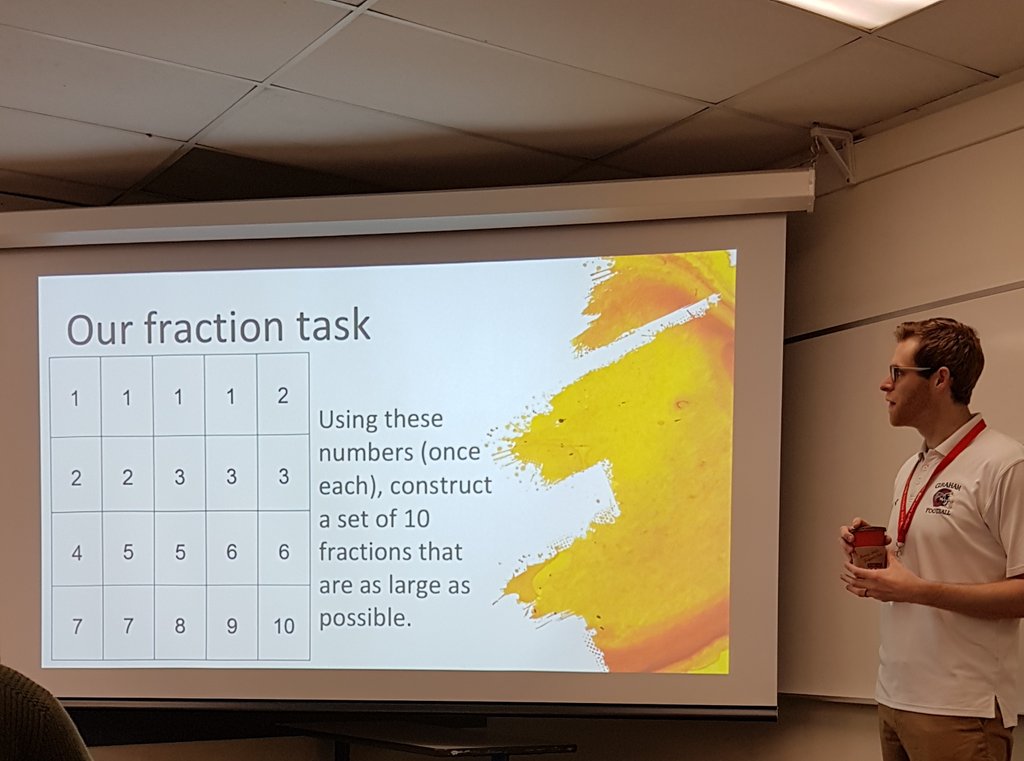
At OAME 2018 I had the great pleasure of attending Nat Banting's session entitled "Teaching Mathematics with Open Tasks". The purpose of his presentation, in his own words, was to "build an understanding and appreciation of the interplay between constraints and freedom inherent in any task". Here is one of the tasks that he presented:


As we worked away and came up with our list Nat then said "Oh, I forgot to say that you can't use improper fractions." A few minutes later we were told that we couldn't use the same fraction twice, then later that we couldn't use equivalent fractions. Experiencing this as a student left me feeling like this:


But seeing Nat's teacher moves in action was remarkable. He looked at what each group had achieved and responded accordingly. His timing was perfect and he was a pro at not actually answering anyone's questions! I don't know who coined the term "facilitated chaos" but it is an apt description of the room during this type of task.

This was the kind of session that gets your brain going the more you think about it. And the more you think about it, the more connections you make which takes you deeper again. I'm not sure whether that makes any sense, but suffice it to say that it was great and has me excited to find way of incorporating this into my classroom on a regular basis. It didn't hurt that I was in a group with Sheri Walker, Fawn Nguyen and Jules Bonin-Ducharme and we laughed so much while having great mathematical discussions.

Nat's slides can be found here.

On the drive back to Ottawa, Sheri and I started brainstorming about how we could "teach like Nat". We are both currently teaching Calculus & Vectors so we came up with ideas that we could use in that course. Although we approached things differently - I had already taught cross product, whereas Sheri did this before teaching cross product - we both had very positive reactions.

Today was the day. My students sit in groups so I gave each group a whiteboard as their collaborative space. Here was the basic sequence I went through with my classes for the first challenge.

"Create two 3D vectors that are perpendicular to each other." I circulated and it was interesting to see their first responses. Most of them caused me to say "Oh, I forgot to tell you that you can't use 0." A few groans, but they carried on and came up with new vectors. Then I either said "Oh, you can't use the same number twice." or "Oh, you need to use integers." This eventually became "You must use integers from -9 to 9, but not 0, and they cannot be repeated." The next step was to make the sum of the magnitudes as large as possible. And each group genuinely felt like they could get the biggest magnitude. We had a list on the board of the current largest one. They were intensely engaged and oblivious to pretty much everything else going on. When things didn't work out, there was language used that was not appropriate but it was because they were so involved that they lost that filter. I overheard one student saying to a group mate "You're hella smart!" and another said "No, I won't let them win." No one was on their phone. No one was distracted. It was 100% engagement.


The second challenge (if they were willing to stop the first!) was to choose any two vectors and find a third vector that was perpendicular to both. I was astounded to see that some groups (of diligent, hard-working students) chose a hard path to figure this out because they actually didn't remember (know?) that this could be found simply using the cross product. (This was a good reminder for me - how often do they not learn what we teach?) They didn't even need me to restrict the constraints this time around - they did it themselves. Then I asked them to make the perpendicular vector have the largest magnitude possible. So far, I am winning this challenge, though I would not be surprised if someone comes in tomorrow with a bigger value.

Clearly, I loved this. But my students did too. When the bell rings and you hear "Why is class over?", you know it was a good class. So huge thank you to Nat and to Sheri. Speaking of Nat, he continues to inspire with tweets like this:


I want to do more of this! I would love to hear your ideas. We could get #teachlikeNat trending ;) 

Oh - and you can all learn more from Nat in person at OAME 2019 in Ottawa. He is the latest addition to our list of Featured Speakers!

Sunday, 6 May 2018

Strategies to Help Deepen Understanding in Senior Math - OAME 2018


Sheri Walker and I presented this session together on Thursday at OAME 2018. Just a note for non-Canadians reading this - we consider grades 9 & 10 as junior courses in secondary schools and grades 11 & 12 as senior courses in secondary school. So the focus of the session was on activities and questions that we would ask mostly in grade 11 Functions, grade 12 Advanced Functions and grade 12 Calculus & Vectors.

We started with this activity on domain and range using Desmos. It was originally created by Suzanne von Oy with subsequent edits by Cathy Yenca, Sheri and myself. We alluded to a list of other activities which are in the table below.


The second half of the session was centered around good questions that require our students to think and make connections. We created random groups of 3 and had each group work on the following two questions.

Question 1:


Extension: What if the last number must be a 9?

This came from Open Middle and was created by Kevin Rees.

Question 2:


Sheri came up with this question and we chose it because we loved the various ways that it could be started.

We also created a handout with a few more interesting questions. You can find that here.


There isn't a whole lot on them, but here are our slides. It was fantastic to have such great participation during the session - wish we could have kept going longer!

Saturday, 5 May 2018

Planting the Seeds of Change - OAME 2018

I was honoured to be invited to speak at OAME 2018 about how to move forward in your teaching practice. My talk was really an introduction to many of the great people in the #MTBoS whom I encourage you to get to know through Twitter or by reading their blogs.

Here is the link to my slides. The Marbleslides challenge is still open, if you want to give it a try. And here is a link to Sean Sweeney's blog post about his Marbleslide challenges.

Thanks so much to all those who came to my talk and participated. I hope you will all try one new thing and let us know how it goes!

Image result for oame2018

Thursday, 22 February 2018

MFM2P Update

I started spiraling my grade 10 applied math class a number of years ago and have written daily blog posts for the course twice. The second time, which starts here, also contains links to all the resources I have used.

Every time I teach this course, I tweak and adjust based on the group I have. This semester I have decided to give homework that supports the spiraled approach I take with this course. I am creating one double-sided page of homework per week. Each homework set contains a little of what we are doing in class that week, along with previously learned topics so that students stay on top of the material. So far I am pleased with how it is going.

Here is the link to my Google sheet. There is a column with links which is where you can get the homework sets if you are interested. They are PDFs as I know some people have trouble seeing equations I create using MathType. If you would like the Word files, feel free to send me an email. There are also tabs for the last couple of years so that you can see an overview of what each cycle looks like.


Thursday, 1 February 2018

Feedback Forms

This is now my 4th semester using feedback forms at the start of each course to help me get to know my students. The idea came from Sara Van Der Werf and you should head over to her blog and read all about it - here is the link.

I thought I would share the tweaks I have made this time around as I really like them. They weren't my idea either - my colleague started doing feedback forms in September and it was her idea to add each student's picture, room for them to write how to say their name correctly along with sibling information (thanks, Kara Lee!). I've also shortened it a little so that they write to me 4 times and I reply 3 times. (The first time I did feedback forms I replied each day but then the students kept the sheets - I wanted to keep them to refer to them later.)

This is what mine look like(with an actual picture of each student).


I have already discovered that a student that I taught all of last semester is actually the little brother of a student I had 8 years ago - how did I not know that?!? Anyway - I love these forms and think they are a great way to get to know students. Adjust as you see fit! I have a couple of versions here and here.

Thursday, 7 December 2017

Rate of Change Graphs

In grade 12 advanced functions (pre-calculus) we look at rates of change of functions. Our students have been working with rates of change since grade 9, but we now look at instantaneous rates of change, or slopes of tangents to a graph, along with rates of change of slopes of tangents. This can all be rather confusing to students so I decided to make a game to help my students build up their skills and vocabulary.

I started by placing all the desks in pairs, facing each other. Each pair had 2 small whiteboards and markers. I randomly assigned the pairs and had them decide who would be person A and person B.

Here was their challenge -


They jumped right in and were asking each other good questions. I paused them at one point and we talked about the fact that, as they couldn't ask about the actual graph, the person drawing should be able to come up with the shape of the graph but there could be horizontal and vertical translations. 


They soon discovered that the orange piles had more challenging graphs and actually chose those ones! Once they had each gone through a number of graphs, I suggested they could make their own. And, boy, did they! Here are some samples:


Along the way there were great conversations and many misconceptions came to light.

My colleague suggested having students create velocity-time and acceleration-time graphs based on the green and orange graphs (assuming they were position-time graphs). That produced even more misconceptions.

It was great to see them engaged and challenging each other in a really positive way.

Here are the graphs that I used - the first 6 were the green graphs and the last 6 were the orange graphs.


Thursday, 16 November 2017

Log Graphs

I was recently inspired by this tweet from Alex Overwijk:


I created my own set of logarithmic graphs - ten with base 10 (white paper) and ten with base 2, 3, 4 or 5 (green paper).


My students, in random groups on big whiteboards, had to determine the equation of the graph they chose. All groups started with base 10 graphs (many stayed with those for the whole activity) and checked their answers on Desmos (and with me). I had printed two sets so they had plenty of new graphs to choose from when they correctly identified their graph. I didn't give them a lot of hints as I circulated as I really wanted them to find strategies to help determine the equations. They were using what they could see about the graph (vertical asymptotes, for example) to help map points from the parent function to their graph. I was really impressed with their efforts. I did decide to write the base on the graphs that were not base 10 as I thought it was too much of a step up at that point.

Here is some of what I saw:


Here is the file. Thanks for the idea, Al!

My plan is to revisit these graphs when we solve logarithmic equations which will allow them to use algebraic skills to help find the equations without having to know/guess which point was mapped onto each new point.