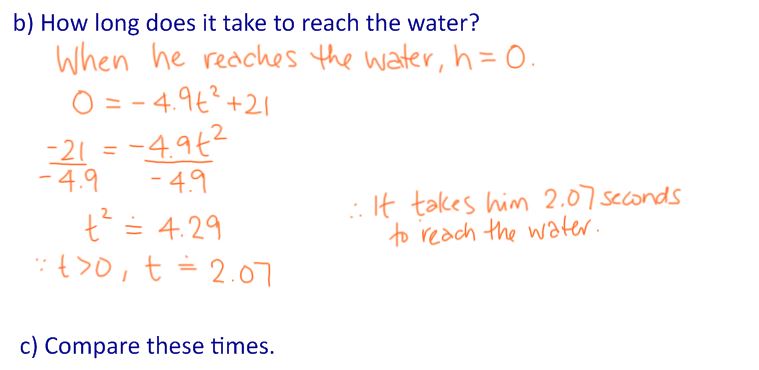
We started today with a couple of leftover examples from yesterday.
We talked about the fact that the second answer is not double the first as the diver is speeding up.
They had done problems similar to the next one for homework, but I wanted to make sure that they were all solid on how to approach this type of question.
Then we moved on to making frames, inspired by (stolen from) Fawn Nguyen. Here is her post about it.
Each pair got one picture (I use black & white pictures as they look better photocopied) and four frames (on thicker paper) to work with as I told them their first attempt would likely be unsuccessful, but that they should learn from it.
Eventually they wanted help. They didn't quite beg for it but they did ask for the math that would help them. That was good. I gave them this and let them have a little more time to work it out.
Then we went over the solution together.
Here is one group's finished product!
After that they worked on one more problem.
Time was tight so we looked at the solution in a Desmos kind of way. I explained how to set up the equation - that the variable was the number of decreases in price. They usually find these questions tough.
And their homework for today:
I left it very open-ended as I want them to make something that is meaningful for them.
I struggled with the title of this lesson and blog post as all the "problems" are "math land" questions - we wrap a fake context around what we want our students to show us and ignore real world constraints. However, here is what we did today.
We focused a lot on what we were trying to find and which tool would get us there, with stops along the way for those students that were lost and confused. Here is another one:
And a third example:
Here is today's homework.
I planned on looking at perfect square trinomials and moving on to completing the square today, but that did not happen. I had several students tell me that they just weren't getting factoring. I know that this is in part due to some of the "ugly" questions they faced for homework last night, but also that they don't have enough experience to recognize how to factor. I had that internal debate between "we need to move on" and "they don't get it so we need to slow down" and the vibe in the classroom told me I didn't actually have a choice.
We started by finishing yesterday's work.
Then we factored. A lot. They all may have nightmares tonight of me saying "Is there a common factor?"! Here is a sample:
See how I sneaked in talking about perfect square trinomials? We did another one later and when I said "I know that's a perfect square trinomial", several students asked "How can you tell?" - setting things up for tomorrow! Back to #11 for a minute. Can someone tell me if there is a way of factoring that with tiles without first factoring out -1? I can't figure it out and it's bugging me.
Update: thanks to Hélène Matte for showing me what I couldn't see yesterday (so tired...)
Now I know I lost many of them when we did this one (which I love because I'm weird like that):
but I still think they are ahead of where they were at the beginning of class. The types of quadratics they need to factor to solve problems for this course are not like this. The most complicated are ones where they have to take out a common factor and are left with a complex trinomial. I'm not entirely sure why we ask them to factor all kinds of crazy expressions beyond that we had to do them and some of us really like factoring them.
I feel like I need a separate blog post about what I have done in terms of teaching my class factoring this semester. That is, what hasn't worked well and how I plan on fixing it for next time. However, with a new puppy and the craziness of December (which includes 4 family birthdays in my case), that may have to wait a bit. Feel free to bug me about it though :)
Here is today's homework - I told them they may not be able to do question 1. Thankfully the rest was all lagging homework.
We finished up the last example from yesterday's work to start today's class. We addressed a few issues, including how to evaluate -(4)(-4). I asked them all to evaluate (2)(3)(5). It was cool that some had multiplied 2 & 3 first, and others 3 & 5, but the point was that they all got 30. No one multiplied both the 3 and the 5 by 2. We tied this back to -(4)(-4) which I wrote as (-1)(4)(-4) and contrasted with (-1)(2x + 3) where the distributive property applies. With that misconception (hopefully) cleared up, we moved on to one of my favourite activities. It is from Shell and can be found here with the full pdf at the bottom of the page.
Students have to match up linear and quadratic expressions in words, algebraic form, tables and area models. Each pair received the 4 sheets on good, brightly coloured paper and cut out the pieces. My students were having great mathematical conversations, were arguing and really engaged for the entire class. Here are some pictures of their work along the way.
I did warn them that there may not be 4 pieces to each match. In fact, some have 6, another only has 1 (they add the ones that are missing). As I circulated, I had good conversations about concepts like whether 3n^2 was the same as (3n)^2. The area models really help me guide students without giving away the light bulb moment.
This is what the back of my classroom now looks like:
I will leave a note to my future self - most students need a full 75 minutes to complete this activity.
I gave them this "Quadratics - Putting It All Together" handout for homework.
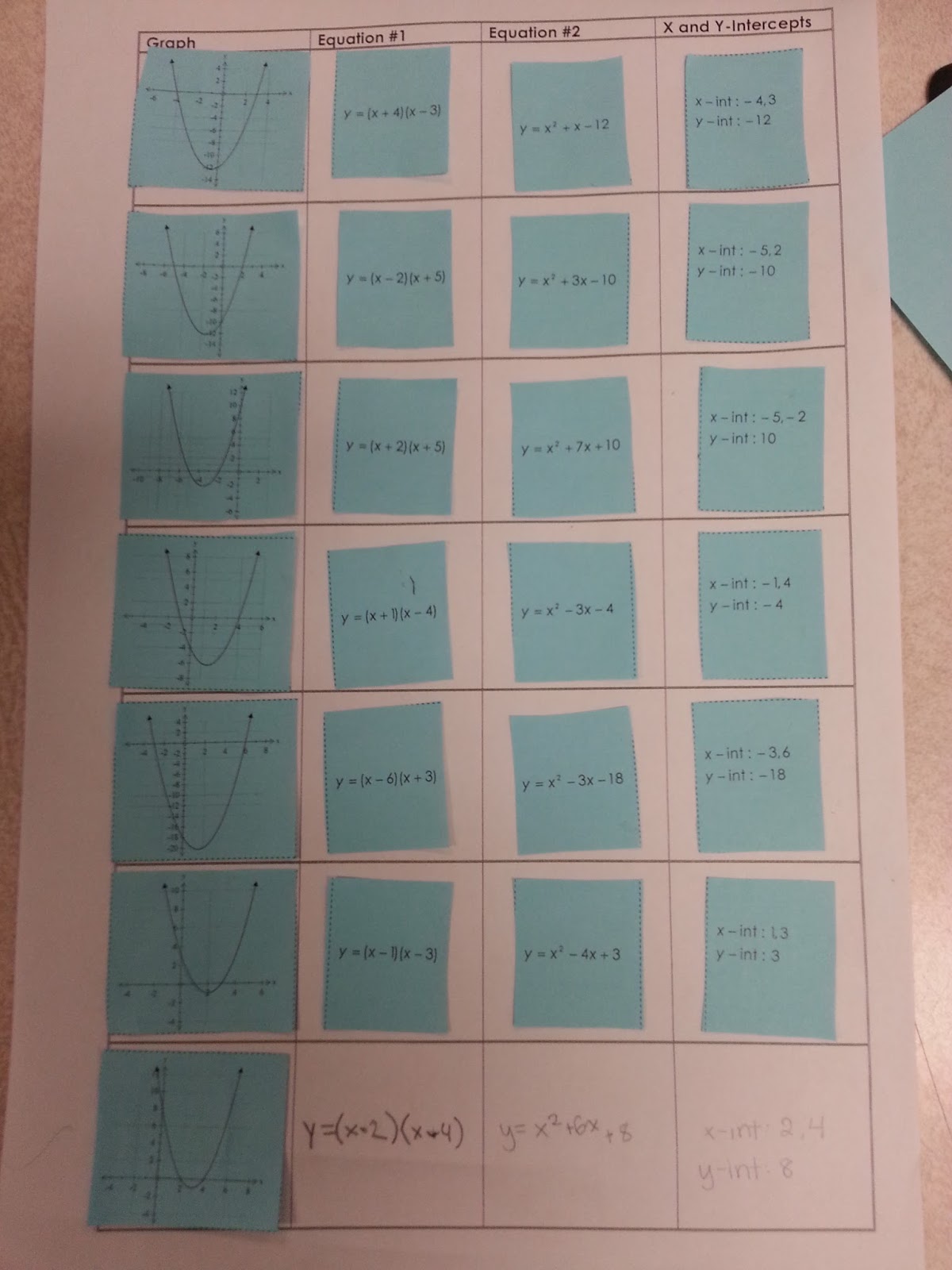
We started today's class with this matching activity that I got from colleagues at Sir Wilfred Laurier Secondary School. My students worked in pairs (mostly) and did a really good job. They were seeing the connections between the zeros and y-intercept of the graph and the numbers in the equation written in factored form and between the equation in factored form and in standard form.
When the first group finished and they wanted me to check their work, I said they could check it themselves! Yes, it was time to formally introduce them to Desmos. I showed them how to enter an equation and how simple it was to get coordinates of interesting points:
While we were there, we talked about the connections between the intercepts and the equations. I suggested that anyone who was struggling with part of the matching could jump on Desmos for some quick help and that they could use it to check their homework tonight.
I wanted to do a little consolidation today and here is what it looked like:
We didn't actually get to part (b), but I filled it in so I could post it in case a student wanted to look it over tonight. Here is homework set 7.
After playing Frogs with my kids at home yesterday, I now have the pattern down. I think there are a number of interesting patterns involved in the game. The goal is to switch all of the pieces from one end, with the pieces at the other end in the fewest moves possible. Moves are a slide forward or a jump over a single piece to an empty spot. I used pieces from my daughter's Pengaloo game last night:
My students started playing in class yesterday, but didn't have enough time to get very far. Today, they played for real:
They were proudly working together to figure these out, even taking videos when they got them! Many really wanted to do four pairs which was more than I expected them to do, but they were excited to have figured out the "trick". I demonstrated four pairs for some groups that were finding this more challenging so they could also add that to their data table. They then found the pattern in the number of moves which they used to determine the number of moves for 10 pairs.
Since we had done a fair amount of work around quadratic relationships, I thought it was time to summarize the connections between a scenario in words, the data, the equation and the graph and to introduce new vocabulary. Here is the handout.
Here is the whole process that we went through together:
And then the vocab:
Next they worked on some quadratic scenarios on their own (well, in their groups). Here is that handout. The first scenario was: "A ball is thrown from 5 m, reaches a maximum height of 9 m after 2 seconds, and lands after 5 seconds." Translating this to a graph was proving to be challenging for many so we looked at it together:
I also provided the equations as I could not show them how to use Desmos to perform regressions (projector was not working) and that really wasn't the purpose of this exercise.
The homework will (hopefully) help them see the link between the graph and the equation (in factored form). And here is that homework for today.
After looking over my class' Linear Review homework, I decided to give my students some time at the beginning of class to go over their errors and make corrections. I wrote the answers on the board and let them work in their groups (they sit in groups or 4 or 5). I wanted to make it clear that correcting errors is a really important part of the learning process. I post the full solutions on Edmodo so they can also look at those if they get stuck.
We then started the High Five activity. Imagine that you are at a sporting event and as each player is introduced, they high five all of the previously introduced players. What will the total number of high fives be once all players have been introduced? I had a student volunteer to be the "announcer" and several more who came up, one at a time as players, each high fiving (that isn't really a verb) all of the other players. We recorded the TOTAL number of high fives after each player arrived.
They soon saw the pattern and my players and announcers were rewarded with a lollipop before returning to their seats. We recorded the pattern in the total number of high fives (1st differences) and then the pattern within the pattern (2nd differences). They created a scatter plot (the link to the handout is below) which I did using Desmos. We talked about the shape of the graph before they started working on finding its equation.
All that visual pattern work really paid off as they were able to find the "rule" for this quadratic. Many recognized the numbers 3, 6, 10, 15... and found that those were in pattern #11. That was the pattern where we had to double to find the rule.
They then had to use their rule to find the number of high fives for the whole school (approximately 1240 students). Once they had that answer, I asked how long they thought it would take. We estimated 1 second per high five, assuming that everyone was perfectly lined up and ready to go. They really had no idea how long that number of seconds was so we worked that out too, just for fun.
We spent the last little bit of class playing Frogs. They understand what they need to do and some were starting to get the pattern, but we will work on that more tomorrow. I'll fill in the details then.
Here are the handouts for High Fives, Frogs, and the pizza one that I assigned as homework.
We started the week by looking at the remaining visual patterns, starting with this one:
Here is the next one:
I have to say that my students are rocking this! They really seem to understand how to relate the length and width of a rectangle back to the step number. We looked at different ways of seeing the shape grow for pattern #10:
And this is how we came up with the rule:
Then it was time for pattern #11:
I told my class that I had been unable to figure out a rule for this one algebraically so I had reached out to my math friends and Dave Lanovaz showed me a brilliant way of doing it. Here is the way I showed my class:
The original pattern was in blue. I repeated the pattern in yellow, then put them together thus creating rectangles! <insert angels singing> I asked if they could find the rule for this pattern and they all said yes. When I asked what they had to do to get the rule for the original pattern, they said we'd have to divide by 2.
Here is what we did:
With that, our visual patterns came to an end. At least for now.
I decided to spend the rest of the class multiplying binomials in a somewhat more formal way than what we had done last week. We started by multiplying numbers, beginning with 23 x 51. It was eye-opening to watch them attempt this without a calculator. So many place value issues and *magical* answers with no work and no ability to explain what had been done. Then I showed them how to break up the numbers like this:
One student actually said that this was like a miracle! She has been relying on a calculator for as long as she has been allowed to and I don't think she understood how to multiply properly until today. At the end of class she even said that this was fun. (O.M.G. day made!)
I did explain that the area models should be representative of the size of each number, like this (which I stole from Tina Dittrich):
We went on to repeat the process with variables in the mix:
Then we went over the distributive property again, which I also demonstrated with a trinomial multiplied by some crazy quartic function. The point being that it works regardless of how many terms are in each set of parentheses.
My students now all have a tool they can use to successfully multiply binomials. I then put up four more examples and wrote a student's name next to each. I explained to them that whenever they go to put work up on the board, they can choose to insert mistakes along the way. So we will never know if someone actually made a mistake or if they planted one for the class to find. My goal in doing this is to ensure that no one ever feels dumb for making a mistake in front of the class. They will (hopefully) come to appreciate all the mistakes and learn from them so they won't make them come test day.