Wednesday, 25 July 2018

Unsolicited Post-TMC Advice


I have been staring at a blank page for some time trying to figure out how to frame what I want to say. TMC18 has come and gone, but the energy that fuels the participants lasts far longer than the four days of the conference. The ideas that are planted during those four days spark enthusiasm and give new life to tired souls. I do not want to dampen any of that enthusiasm but want to throw in just a note of caution.

I have now taught for 24 years and the 24th was, by far, the most difficult. For whatever reason, there was more negativity from both parents and students this past year to the point that I questioned whether I wanted to continue teaching. Although a number of teachers had to deal with these storm clouds, I think I felt it most because I do things differently. I spiral my curriculum and my homework, I don’t teach from the textbook, I implement the elements of a thinking classroom. I do these things because I truly believe that they have a positive impact on my students’ learning. But not following the pack means that difference gets pointed to as the reason for any issues. And as much as I wish I could let all the negativity wash off like water off a duck’s back, I can’t. I take things very personally and felt crushed. I’ve been trying to let it go and get past it, but it all came flooding back when Julie Reulbach had everyone tweet out why they are a great teacher. All I could think is “I’m not” and I sobbed through most of her keynote. I have great friends who have told me that I am good at what I do, but the seed of doubt that has grown over the past year is hard to dismiss. 

So here is my advice. Don’t try to do ALL the things. Choose your #1TMCthing and dive in but if you are making substantial changes to what is considered the norm at your school, make sure you have a support system in place first. Knowing that someone has your back is empowering, just as finding out that no one really does is heartbreaking. Set yourself up for success and don’t forget that you’ve got the #MTBoS on your side.

Tuesday, 24 July 2018

TMC 2018 - We Have So Many Questions!

Image result for tmc18 logo


Last week I had the privilege of being at TMC18 in Cleveland and was honoured to present a morning session entitled "We Have So Many Questions!" with Sheri Walker. Sheri and I work in the same city, but not at the same school, so we collaborate over email and occasional meetings at PD days or over coffee. We both like to create rich questions that promote deeper thinking in our students and help them make connections. These types of questions were the focus of our morning session (6 hours over 3 days). We had our participants work in random groups of three on whiteboards (#VNPS) on interesting questions (we did lots of math - yay!) before creating some of their own. We were so fortunate to have the most amazing group of educators who were all willing to jump in and try new things. They were a joy to work alongside - helping each other, pushing each other's thinking and ours, too.


Morning Session 2018 (+ Graham & Jon)


The link to the slides is included below so you can get a sense of the kinds of questions we shared, but I thought I would give those of you who were not part of our session a taste of what we did on days 2 and 3. So get out a pencil, pen or marker and do this question. 


(Don't worry - I'll wait and post some pictures for the interlude.)


Graham attending to precision

Danielle was super proud of this one!


Not that interesting, right? It looked interesting and different when I saw it here, but it turned out to be super easy if you know that the diagonals of a square are perpendicular. But I still thought it had potential. Potential to be turned into a good question so Sheri and I worked on doing that. We would each try our own thing then ask questions then try some more, look at each other's work, get new inspiration and keep going. This is how we collaborate. Before I share what we came up with, I would like you to see what you can do to make this question better. I'll wait.

(A few more pictures...)

Amy & Brad deep in thought


Pam with all her group's WODB reasons


Amy, Mary & Danielle doing a little WODB

Danielle, Sara, Mary, Pam, Mark & Brad working on Algebra 2 questions

I would love to see what question(s) you created - post them in the comments or drop me a line.

Here is what I ended up with. Assuming the same diagram and that segment AB is horizontal, make the coordinates of A(a,11)...

Q: Find all possible values of a.
or
Q: What value of a will give ABCD the greatest area?
or
Q: Determine the equation of AC [if D must have integer coordinates].

Interestingly enough, each group in our session went down a different path with this prompt. 

Sheri working with Mary & Amy; Angie & Brianna creating a cool WODB in the background

This set the stage for day 3 which was all about creating your own questions. I hope that we will all continue to share what we create over the upcoming school year and inspire each other to get the best out of our students.

Click here to see our slides.


Friday, 29 June 2018

Desmos at Exeter 2018

I have had the pleasure of being part of the Exeter math conference again this year.  
Image result for exeter math conference

My slides for the CWiC session on "Getting the Most out of Desmos Activities"


Image result for desmos logo

Below are links to some of what we did in my two awesome classes.

Sunday
Intros with name tents - from Sara Van Der Werf; my modifications
Day 1 Activity Builder
Marbleslides Lines


Monday
Polygraph Lines
Parabola Slalom
Graphing Calculator scavenger hunt: original; beginner as AB
Geometry scavenger hunt
Marbleslides Challenges for the week


Tuesday
Domain & Range
Creating Desmos Activities - check out their videos here


Wednesday
Sean Sweeney's Marbleslides Activity & Google Doc Julie Reulbach's blog post on testing with Desmos
Jonathan Claydon's blog post on testing with Desmos


Thursday
Dynamic labels:
- simple
- line between points
- distance between a point and a line
- parabola
My activity for day 1 of Calculus


Friday

Our Google Doc of cool activities, including a bunch for geometry.

Thanks, everyone, for a great week!

Thursday, 10 May 2018

Teach Like Nat

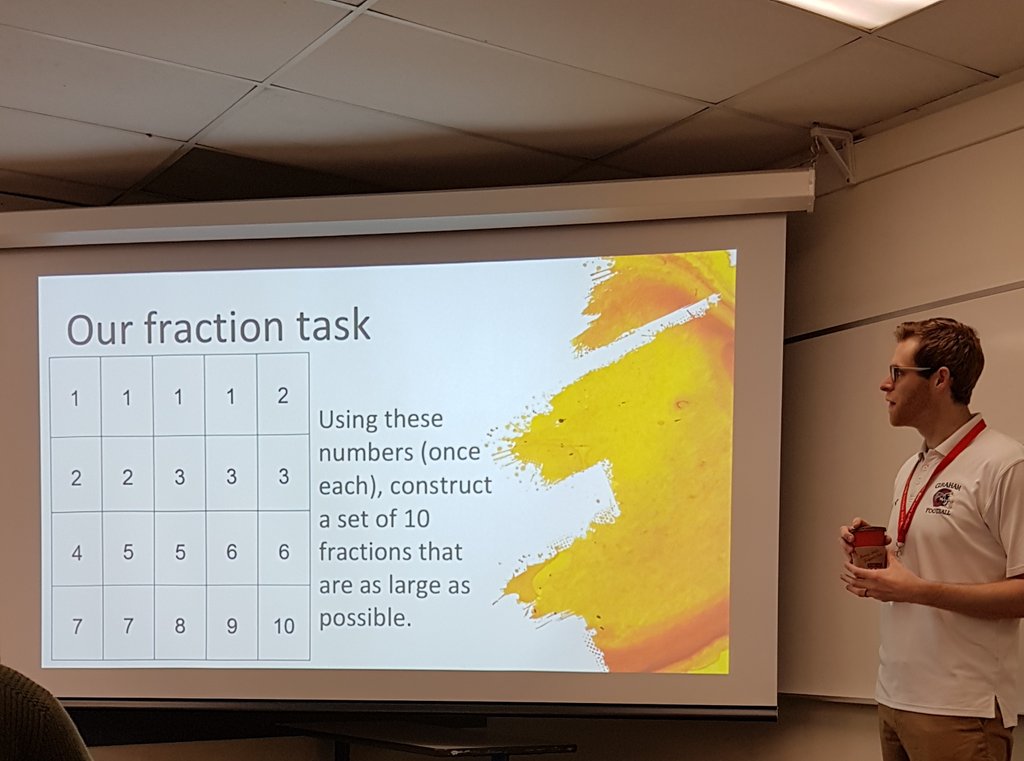
At OAME 2018 I had the great pleasure of attending Nat Banting's session entitled "Teaching Mathematics with Open Tasks". The purpose of his presentation, in his own words, was to "build an understanding and appreciation of the interplay between constraints and freedom inherent in any task". Here is one of the tasks that he presented:


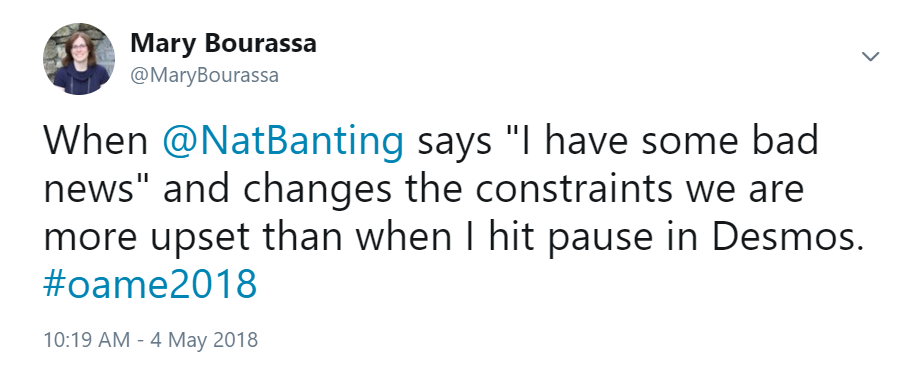
As we worked away and came up with our list Nat then said "Oh, I forgot to say that you can't use improper fractions." A few minutes later we were told that we couldn't use the same fraction twice, then later that we couldn't use equivalent fractions. Experiencing this as a student left me feeling like this:


But seeing Nat's teacher moves in action was remarkable. He looked at what each group had achieved and responded accordingly. His timing was perfect and he was a pro at not actually answering anyone's questions! I don't know who coined the term "facilitated chaos" but it is an apt description of the room during this type of task.

This was the kind of session that gets your brain going the more you think about it. And the more you think about it, the more connections you make which takes you deeper again. I'm not sure whether that makes any sense, but suffice it to say that it was great and has me excited to find way of incorporating this into my classroom on a regular basis. It didn't hurt that I was in a group with Sheri Walker, Fawn Nguyen and Jules Bonin-Ducharme and we laughed so much while having great mathematical discussions.

Nat's slides can be found here.

On the drive back to Ottawa, Sheri and I started brainstorming about how we could "teach like Nat". We are both currently teaching Calculus & Vectors so we came up with ideas that we could use in that course. Although we approached things differently - I had already taught cross product, whereas Sheri did this before teaching cross product - we both had very positive reactions.

Today was the day. My students sit in groups so I gave each group a whiteboard as their collaborative space. Here was the basic sequence I went through with my classes for the first challenge.

"Create two 3D vectors that are perpendicular to each other." I circulated and it was interesting to see their first responses. Most of them caused me to say "Oh, I forgot to tell you that you can't use 0." A few groans, but they carried on and came up with new vectors. Then I either said "Oh, you can't use the same number twice." or "Oh, you need to use integers." This eventually became "You must use integers from -9 to 9, but not 0, and they cannot be repeated." The next step was to make the sum of the magnitudes as large as possible. And each group genuinely felt like they could get the biggest magnitude. We had a list on the board of the current largest one. They were intensely engaged and oblivious to pretty much everything else going on. When things didn't work out, there was language used that was not appropriate but it was because they were so involved that they lost that filter. I overheard one student saying to a group mate "You're hella smart!" and another said "No, I won't let them win." No one was on their phone. No one was distracted. It was 100% engagement.


The second challenge (if they were willing to stop the first!) was to choose any two vectors and find a third vector that was perpendicular to both. I was astounded to see that some groups (of diligent, hard-working students) chose a hard path to figure this out because they actually didn't remember (know?) that this could be found simply using the cross product. (This was a good reminder for me - how often do they not learn what we teach?) They didn't even need me to restrict the constraints this time around - they did it themselves. Then I asked them to make the perpendicular vector have the largest magnitude possible. So far, I am winning this challenge, though I would not be surprised if someone comes in tomorrow with a bigger value.

Clearly, I loved this. But my students did too. When the bell rings and you hear "Why is class over?", you know it was a good class. So huge thank you to Nat and to Sheri. Speaking of Nat, he continues to inspire with tweets like this:


I want to do more of this! I would love to hear your ideas. We could get #teachlikeNat trending ;) 

Oh - and you can all learn more from Nat in person at OAME 2019 in Ottawa. He is the latest addition to our list of Featured Speakers!

Sunday, 6 May 2018

Strategies to Help Deepen Understanding in Senior Math - OAME 2018


Sheri Walker and I presented this session together on Thursday at OAME 2018. Just a note for non-Canadians reading this - we consider grades 9 & 10 as junior courses in secondary schools and grades 11 & 12 as senior courses in secondary school. So the focus of the session was on activities and questions that we would ask mostly in grade 11 Functions, grade 12 Advanced Functions and grade 12 Calculus & Vectors.

We started with this activity on domain and range using Desmos. It was originally created by Suzanne von Oy with subsequent edits by Cathy Yenca, Sheri and myself. We alluded to a list of other activities which are in the table below.


The second half of the session was centered around good questions that require our students to think and make connections. We created random groups of 3 and had each group work on the following two questions.

Question 1:


Extension: What if the last number must be a 9?

This came from Open Middle and was created by Kevin Rees.

Question 2:


Sheri came up with this question and we chose it because we loved the various ways that it could be started.

We also created a handout with a few more interesting questions. You can find that here.


There isn't a whole lot on them, but here are our slides. It was fantastic to have such great participation during the session - wish we could have kept going longer!

Saturday, 5 May 2018

Planting the Seeds of Change - OAME 2018

I was honoured to be invited to speak at OAME 2018 about how to move forward in your teaching practice. My talk was really an introduction to many of the great people in the #MTBoS whom I encourage you to get to know through Twitter or by reading their blogs.

Here is the link to my slides. The Marbleslides challenge is still open, if you want to give it a try. And here is a link to Sean Sweeney's blog post about his Marbleslide challenges.

Thanks so much to all those who came to my talk and participated. I hope you will all try one new thing and let us know how it goes!

Image result for oame2018

Thursday, 22 February 2018

MFM2P Update

I started spiraling my grade 10 applied math class a number of years ago and have written daily blog posts for the course twice. The second time, which starts here, also contains links to all the resources I have used.

Every time I teach this course, I tweak and adjust based on the group I have. This semester I have decided to give homework that supports the spiraled approach I take with this course. I am creating one double-sided page of homework per week. Each homework set contains a little of what we are doing in class that week, along with previously learned topics so that students stay on top of the material. So far I am pleased with how it is going.

Here is the link to my Google sheet. There is a column with links which is where you can get the homework sets if you are interested. They are PDFs as I know some people have trouble seeing equations I create using MathType. If you would like the Word files, feel free to send me an email. There are also tabs for the last couple of years so that you can see an overview of what each cycle looks like.