Today's warm up is our first math talk. And I'm not there : ( They will be doing 12 x 15 without a calculator. I want to see as many strategies as possible. I am always amazed at how many kids will actually draw 12 groups of 15 dots of 15 groups of 12 dots and either count or add up the result. I was sure I had a picture from a previous class that had done this math talk, but I can't find one. Here are some of the strategies that I might see:
My students always come up with ones that I don't think of, which is the beauty of doing math talks. All students see that there are multiple ways of getting to an answer. Regardless of whether you are the top student or one who is struggling, you found a way and can learn from others. If you are not familiar with math talks, you might want to check out Jo Boaler's work and the YouCubed website.
As I didn't know quite how far my students would get in my absence yesterday, I left some really boring worksheets for them to practice calculating surface area and volume of prisms and cylinders. As much as I like to keep my students engaged and don't think these worksheets will necessarily do that, I think some will need the practice and my substitute teacher will need something concrete for them to work on. Working with triangular prisms is especially tricky for many of my students so this will hopefully help them work out the kinks in their thinking.
I also left them this 3-act to work on.
I hope I am "tricking" them into remembering that the sides of a cylinder come from a rectangle while doing some hands-on work. Thank you, Dan Meyer, for again helping me make my class better.
I am at a math conference today through Sunday so today's and tomorrow's blog posts are what should be happening in my class in my absence. I suspect reality will be somewhat different!
Today's warm up is this Would You Rather:
I happily let my students use their phones to find out the mass of a penny (hmmm, we don't have pennies in Canada anymore) and the mass of a quarter. I suspect that some groups will work with the mass of American coins (because when they Google it that may come up first if the word Canadian is not in there) while others will have Canadian coin masses which will be slightly different. So here is what I found:
and then I looked for the Canadian equivalent and this is what I found.
For the penny:
For the quarter:
Whoa! Look at the mass of a penny from 1908 to 1920. There is some interesting data in here that would likely had led me on a tangent with my class (!). I love that both the US Mint and Canadian mint list the masses in grams and that the Would You Rather is in pounds. Students need to do some conversions in context and make sense of their answers. Wish I had some student work to show.
After the warm up they will work on yesterday's handout some more. I hope they will realize that the volume of a prism and a cylinder is the area of the base multiplied by the height. Having them estimate first, with actual blocks or pictures of blocks, should help them see the layers.
They will spend the last part of class doing Andrew Stadel's File Cabinet 3-act activity.
I love this one and they do too.
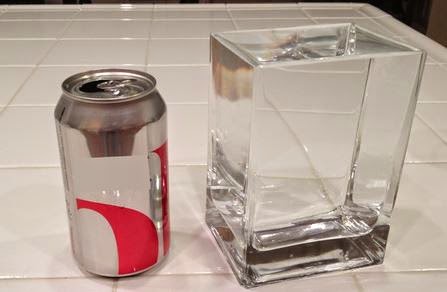
Some of my students finished their test yesterday, but many didn't, so they continued today. Those who had finished worked on the warm ups from yesterday and today. We did this Estimation 180 as it ties in with what we will be doing for the next few days.
One of my students got it exactly right. He said that he thought the vase was about double the volume of the can. Not having done the previous Estimation 180s, he assumed the volume of the can was 355 ml, as is the case in Canada. In the US, the volume is 370 ml. It's ironic that had he known the actual volume of the can shown, he would not have gotten the correct volume of the vase.
The 2nd warm up was this Visual Pattern:
Most got the rule, but some are still having trouble explaining how they got it. Here is what we did with it:
By this time only a couple of students were still working on their test (one was away yesterday) so we moved on to this handout.
Students were building rectangular prisms with linking cubes where the dimensions were randomly determined by rolling a die. They had to calculate volume and surface area.
Many students did not know how to build their prism once they had their dimensions. This reinforced the need to have them build. I circulated and helped them understand how to build their prism, what volume represented (number of cubes) and how to calculate it based on the dimensions of the prism. Some knew how to find surface area, but many did not know where to start but having the physical model in front of them made it really simple to explain it to them.
They will continue tomorrow and add cylinders and triangular prisms to the mix.
Today is the first test. Students have learned material from almost all the overall curriculum expectations and I get to see how they are doing with it. We did not do any measurement (SA & V) as the timing worked out better for the test to be today (and tomorrow) so they can work on surface area and volume questions while I am away at a math conference on Thursday and Friday.
What does test day look like? Desks in rows instead of in groups and students work away at their questions using graphing calculators and manipulatives as needed. They have trig tables on their desks and some have a graphing calculator instruction sheet as reference. No one is talking but it is not always quiet as you hear the sound of pennies shuffling across desks as they solve the system of linear equations. They get up to collect what they need and to return it - small body breaks for some that need it. I tell them to start with whichever question they like - the order is not important. I will soon be circulating with my orange pen to give prompts if needed on questions they have left blank. They almost always know more than they show and pointing them in the right direction to get them going lets me see more of what they can do. As my prompts are all written on their test papers in orange pen I can take them into consideration when marking. If any student does not finish the test today, they will continue tomorrow. Time is not a factor. Quitting before truly attempting all questions is not an option. Generally, my grade 10 applied students are not afraid of asking me questions - they seem less afraid of appearing "stupid" because they don't know something (I remind them that they are learning and are all smart). I know this fear all too well - I often do not reply to interesting tweets because I don't want to appear foolish or wrong, but I am working on that! I think my students trust me and know that I want them to do their best. Sometimes it is my job to believe in them even when they don't believe in themselves. This is one time when I am happy to prove them wrong.
Today's counting circle started at 12 and went down by 5. We talked about strategies such as going down 2 to get to 0 then down the other 3 to get to the answer. I also stopped them at one student and asked what number we would be at 7 students further along. The strategies for that are shown on the right side of the picture.
We spent the rest of the period working on this review handout. They were doing quite well, asking questions and talking about the math. They had graphing calculators and manipulatives at their disposal. I will be emailing the solutions home so that they can finish preparing tonight.
We did this balance bender as today's warm up:
I had a student write his solution on the board - it is below, but just the numbers in black! We spent a bit of time going through explaining what each of the numbers meant and why it is important to include this information as part of a solution.
I also told them that what they were doing to solve this was the same reasoning they do with algebra.
I went through it throwing in variables so that they could see that the process is the same and I told them that if they prefer to work with the pictures, they can turn equations into pictures.
Today was our first day solving systems of linear equations. I gave them this handout and told them to get into groups or 2 or 3. I had pattern blocks and pennies out for them and set them to work. I circulated and helped get each group going.
Here is one example:
and this is what it looks like, solved:
The orange squares represent jujubes and the blue diamonds (what's the plural of rhombus?) represent Smarties. They took 33 pennies for the right side and 18 pennies for the left side and moved them around until they had the same number of pennies for each jujube and the same number of pennies for each Smartie. That was the solution.
Had I given them a system written like this:
they would have stared at me and given up. But this is the same system they just solved!
Here is another:
and the solution:
They worked through the handout at their own pace. One group finished solving all the systems and started creating their own. The others all understood the process and what they were trying to find. A good way to finish up the week!
Today's warm up was this Would You Rather:
They mostly worked in groups on the big whiteboards. Many groups wrote 50 x 3 = 150 and 25 x 5 = 125 and they circled the second calculation as the better option. But what did the 150 and 125 mean? They couldn't tell me. One student even told me that those numbers had no meaning. This was the big takeaway for my class - just because you have numbers doesn't mean that you should necessarily start calculating with them. We discussed how the 50 lb box would be harder to carry up that third flight of stairs than it was for the first flight of stairs. Some told me that 50 lb wasn't heavy so they were okay with carrying that instead of the 25 lb box. There were interesting discussions and they agreed that this was an opinion question (because they don't have the physics background to work with) and it depended greatly on their level of fitness and how strong they were.
Today I was bound and determined to finish Boat on the River 3-act. But we didn't. Sigh. I started by getting them to add a "find an angle" trig question to their exercise books:
and I thought this would be an excellent opportunity to review sum of squares so we did that for the same triangle:
They practices a few more trig questions (finding the angle, only) before the quiz. Open-book, again. Some similar triangle questions followed by sum of squares and trig. I was pleased that when some of my students seemed stuck, they responded really well to a quick prompt from me. I also really loved it when a student asked for highlighters for the similar triangles questions.
No time for Boat on the River, but I will get back there!