Today started with a warm up and the small whiteboards.
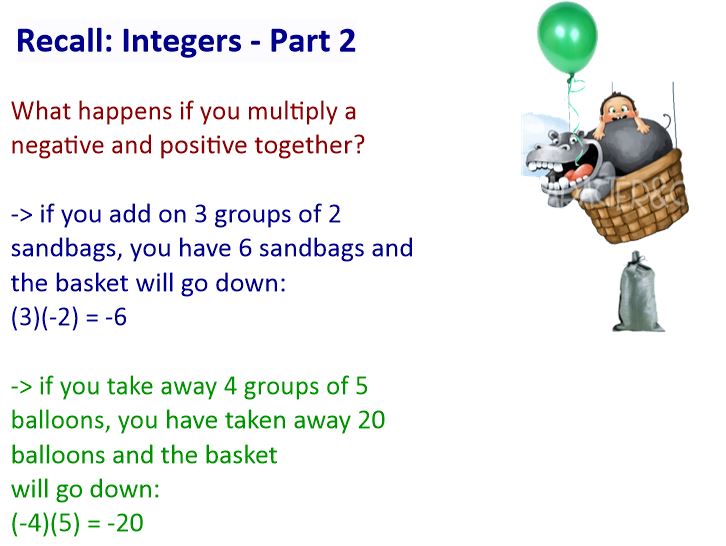
Again, there were many different answers so we went over a few things. We talked about what the dot means and why it is used and a little about order of operations - that multiplication happens before addition or subtraction. Then we did a little recall on multiplying with integers.
We went back to the warm up and I gave them a minute or two to check their work before we took it up.
I took out my playing cards and they created groups for today's visual pattern. They worked on the whiteboards and are slowly getting better at showing the link between the pattern and the algebraic expression. Here is one sample and the sample solution I showed them.
Next we moved on to the activity that we didn't have time for yesterday. I had prepared a brown paper bag with algebra tiles for each pair of students.
We went over what each tile represented before they tried this out. It seemed to solidify the concept of zero pairs pretty well.
Next we did a more formal lesson on like terms. Well, we started. We didn't get through everything and I have to remember that rushing through material serves no one. If I try to think positively, I have part of my lesson for tomorrow ready to go!
We did example 1 as a class - it was a good consolidation of the activity they had just done.
We defined like terms and started on the next example which produced some really good discussion.
And that's all for today. I know we are doing a lot each day so I need to consider whether I need to make some adjustments to my plan to provide a little more breathing room.
We didn't have class yesterday as the school buses were cancelled, so I'm considering today as day 2.
Before class I handed out small whiteboards and markers and organized bags of algebra tiles (which I won't get to until tomorrow as it turns out).
We started with this warm up which students did on their small whiteboard:
I circulated and then wrote - 10, -5, -2, -6, -4, -7, IDK on the board. Those were some of the answers I had seen. Clearly we had work to do. The reason I wrote all of those answers was for them to see that many students didn't know how to do this correctly - that if they didn't get it right, it was okay. We would work on it together. We then talked about adding and subtracting integers (I have an old blog post about this here).
Then I let them try the warm up question again with much better results.
Next up, today's visual pattern (#129 but I removed the colour as I found it too leading). We used cards to create random groups of three and their task was to figure out the rule for the pattern in as many ways as possible.
I confess that I didn't circulate, listen and engage with my students enough while they were doing this as I was also handing out textbooks. However, I was really pleased with the work they did, the fact that no one went to a table and that they are starting to be able to show their thinking. Here are some samples (some got a little help connecting the representations from me):
I had two possible ways of seeing this pattern ready to go, but added a third to capture some of their thinking - many groups made a constant in the middle of the vertical part. Here are those:
I love that there are so many different ways of seeing these patterns and am always impressed when my students show me a new way of seeing it.
Next, we talked about algebraic models: using algebra tiles to represent expressions.
We had just enough time for them to try a couple of examples. Honestly, I was too rushed doing this and should really have let touch the actual tiles to truly understand. I will fix that tomorrow.
We wrapped up by returning feedback forms (not sure I talked about those - read about them here).
I'm dusting off the old blog to help me reflect on my first unit of grade 9 academic math. I last taught this course in 2013 and was not happy with how the first unit went so I am making some changes this time around. My plan is to blog daily so that I have a record of what I did, how things went, and what I would do differently next time.
Unit 1 is all about polynomials. Like terms, distributive property, exponent rules. All mixed in with integers and fractions, which are pretty shaky concepts for many of our students. My plan is to work on integers and fractions as daily warm-ups and through the lessons to slowly bring everyone up to the level they need to be in order to be successful. But I'm getting ahead of myself.
Today we started with a puzzle that I found in our textbook (McGraw-Hill Ryerson). I had students pick cards to form random groups of 3 and they worked at the whiteboards around the room.
I included a hidden extra clue but none of the groups needed it (yay!). They did really well, in terms of the mathematics but also working in teams. I had an extension ready to go for the groups that finished quickly - I asked them to work on creating their own magic square (still 4 x 4) but using some negative numbers. That was very challenging, so I think I might ask them to create a 3 x 3 one next time around.
With about 20 minutes remaining (our classes are 75 minutes long), we started our first visual pattern together. If you are not familiar with visual patterns you should head over to Fawn Nguyen's site by clicking here.
We came up with three different ways of seeing the pattern growing. For each one we came up with the rule based on the step number.
i was pleased with their willingness to work with the pattern and not jump to a table. We will do more tomorrow.
I also asked them to create DeltaMath.com accounts. They will be able to get extra practice there.
Somehow this is the week when I am getting caught up on blog posts. Why this week? Apparently extra chaos in my life helps me need to cross things off my to-do list. Two kids with potential concussions and one feeling like throwing up seems to be the motivation I need to blog. Go figure.
Ages ago, in my grade 10 applied class, I made a new intro to similar triangles. I liked it mostly because it was simple and allowed my students to practice other skills they had recently learned, namely right-angle trig and sum of squares (Pythagorean theorem). It looked something like this - what "What do you notice?" at the bottom.
This is what we did with it:
Nothing fancy, but it worked so I thought I would share. I think this qualifies as #unsexymath.
If you would like the file, you can find it here.
I have not blogged for a while and this post is about six eleven weeks overdue. On the first day of school I do the marshmallow challenge with my grade 12 classes. I do not know who deserves credit for this activity (if someone knows, please pass that along) but it's a great team-building exercise that requires collaboration to be completed in the time allowed.
I hand out cards to organize students into random groups. They start by introducing themselves to their teammates. I then have the groups brainstorm ideas before the clock starts. And then the fun begins. I love watching them try strategies and listening to their conversations. Inevitably they frantically try to finish before the time runs out only to see their structure tilt over when they place the (surprisingly heavy) marshmallow on top. I measure the towers to determine a winning group, but it's really not about winning.
What I did differently this year, which is really what I wanted to share, was to ask debrief questions after the activity that mirror the great things I see during the activity. I wanted them to think about how collaborating can help a group reach a goal. How it is important to listen and to talk and that it is important that everyone in the group is engaged. You can find the questions I asked here - I looked at ones that others have asked to get ideas so thanks to all those who have shared in the past. I want to focus on a small, but important part. I start by having them fill in this table:
Firstly, they needed to know the names of their teammates. Secondly, they needed to say something complimentary about each of their teammates who are often people that they have never really interacted with before. And they did. They did such a good job. They all found things that their teammates did well. This was important to me because I believe all my students bring positive things to my class. And that along with learning math, we will learn how to be good, kind citizens.
I'm very excited to announce that we are now accepting speaker proposals for the Ontario Association for Mathematics Education's annual conference, taking place in Ottawa on May 16-18, 2019.
We already have an amazing lineup of featured speakers (check out our website), but this conference couldn't be as incredible as it is without all the great educators who volunteer to share their ideas and practices.
In addition to sessions in English and in French, we will have a focus on Desmos on the Saturday of the conference.
We hope you can join us in the nation's capital for three days of mathematical conversations, connections and cheer.
Get started here. I hope to see many of you in Ottawa in May!
As the new school year approaches, I am reflecting on the last and what changes to make for this one to be more successful. Specifically, if implementing a "thinking classroom" with VNPS & VRG (ugh - the acronyms and appropriated terms here do not make me happy), I need to find a way of making my intentions more obvious to students whose initial reaction is to push back because this is not how they have learned to do school. The choice of opening day activity is important to me but more so will be the connections students can make when reflecting on the implementation of that activity. I want them to see that the result was made better from working in a group. I want them to understand that they each have a voice and that their contributions are all important. I want them to hear why I made the teacher moves I did and why I likely did not answer their questions directly. I want them to think about what they are learning, but also about how they are learning it. How being uncomfortable is not necessarily a bad thing. How not knowing the right path to take should not make them feel lost. How important it is to be able to listen to others' ideas and how important their own contributions are. And that throughout it all, I have their best interests at heart and will do my utmost to ensure that they all understand the material more deeply than they would through a lecture.
All of this is difficult for me. My not-as-shy-as-I-used-to-be but still shy and introverted self has a hard time approaching these kinds of conversations. This model of learning is about playing the long game whereas I *need* my students to see the benefits before they actually feel the benefits. I need this for them, but I really need this for me.
Now, back to summer :)